Most Mid-Atlantic homeowners install solar and assume the system will take care of itself. It won't. A solar system can quietly lose 20% or more of its output without tripping a single alarm, and you'd never know unless you're actively watching the data. If your utility bills aren't dropping the way your installer projected, or your monitoring app shows numbers that seem low but you're not sure what "low" actually means, you may already have a solar system underperforming problem on your hands. This article gives you seven concrete warning signs to check right now, and explains what each one means for your home in Delaware, Maryland, New Jersey, Pennsylvania, Virginia, or Washington, D.C.
Table of Contents
- Why Mid-Atlantic Homes Are Especially Vulnerable
- Quick Takeaways
- Warning Sign 1: Production Consistently Below Your Estimate
- Warning Sign 2: One Panel or String Dragging the Whole System Down
- Warning Sign 3: Inverter Error Codes You Keep Dismissing
- Warning Sign 4: Visible Physical Damage You Haven't Acted On
- Warning Sign 5: Soiling and Shading That Wasn't There at Install
- Warning Sign 6: Battery Storage Not Charging or Discharging Correctly
- Warning Sign 7: Your Utility Bill Hasn't Changed Meaningfully
- How to Compare Your Options When Solar Panel Problems Arise
- Frequently Asked Questions
- References
Why Mid-Atlantic Homes Are Especially Vulnerable
The Mid-Atlantic region is not the Mojave Desert. Homeowners in Delaware, Maryland, Virginia, Pennsylvania, New Jersey, and Washington, D.C. deal with a specific combination of weather challenges that most solar marketing materials gloss over: heavy humidity in summer, ice accumulation in winter, significant tree canopy in suburban neighborhoods, and dramatic seasonal swings in sun angle and daylight hours.
These conditions make Mid-Atlantic solar systems more prone to certain failure modes than systems installed in sunnier, drier climates. Micro-cracking from freeze-thaw cycles, heavy pollen and leaf debris causing persistent soiling losses, and inverter stress from temperature swings are all more common here than installers from national brands like Sunrun or Sunnova typically disclose during the sales process.
Understanding what your system should be producing given your local conditions is the starting point for identifying any solar panel problems before they compound into expensive repairs or years of lost production.
Quick Takeaways
Key Insight | Explanation |
|---|---|
Production gaps compound silently | A 15% underperformance you ignore for two years represents a real financial loss on your investment, not just a number on a screen. |
One bad panel can pull down a whole string | In systems without module-level power electronics, a single failing panel reduces output for every other panel wired in series with it. |
Inverter error codes are not minor alerts | Repeated or persistent fault codes are early warnings of component failure, not routine system behavior. They need to be logged and investigated. |
Mid-Atlantic pollen and leaf fall are genuine performance threats | Heavy spring pollen and fall leaf accumulation can reduce panel output measurably. Seasonal cleaning is not optional maintenance. |
Battery storage problems are often misread as solar problems | If your battery isn't charging or discharging correctly, your home may be pulling more grid power than it should even when the solar array is performing fine. |
Monitoring apps require active review, not passive glancing | Looking at daily totals is not enough. You need to compare against a production baseline for the same month in prior years or against your original estimate. |
A solar repair specialist is different from your original installer | Many large national installers do not prioritize service calls on older systems. An independent licensed contractor focused on diagnostics and repair will give your system more attention. |
Warning Sign 1: Production Consistently Below Your Estimate
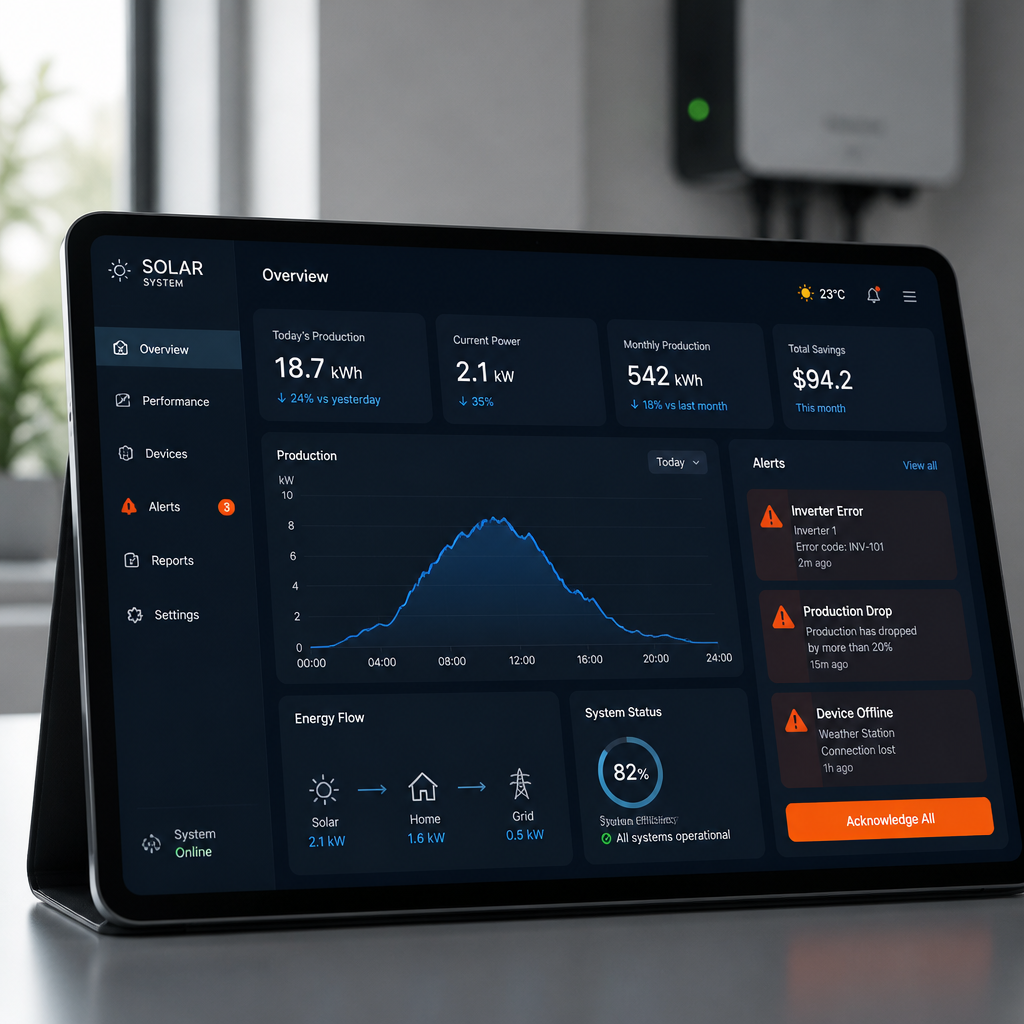
Every solar installation comes with a production estimate, usually expressed as annual kilowatt-hours. This figure is your baseline. If your monitoring system shows actual production running 10% or more below that estimate for several consecutive months, that is not a rounding error. That is a system with a problem.
In practice, production varies from month to month because of weather. But a well-functioning system in the Mid-Atlantic should come within a reasonable range of its annual estimate when averaged across a full year. Consistent shortfalls, especially when skies are mostly clear, point to something wrong: degraded panels, a partial inverter fault, wiring issues, or shading that wasn't present when the system was designed.
Pro tip: Pull your monitoring data for the last 12 months and compare it against your original installer's production estimate. If you no longer have that document, your installer is legally required to have provided it at contract signing. Request a copy and run the comparison yourself before calling anyone.
The U.S. Department of Energy's Federal Energy Management Program, in its analysis of photovoltaic system performance at federal sites, found that underperforming systems often showed no outward signs of failure but consistently produced less energy than their rated capacity. The same pattern applies to residential systems.
Warning Sign 2: One Panel or String Dragging the Whole System Down
This is one of the most common and most under-diagnosed solar panel problems in residential systems. In a traditional string inverter setup, panels are wired in series. That means if one panel is underperforming because of damage, a defective cell, or even persistent bird droppings, it restricts the output of every other panel in that string, not just itself.
How to Spot a String-Level Problem
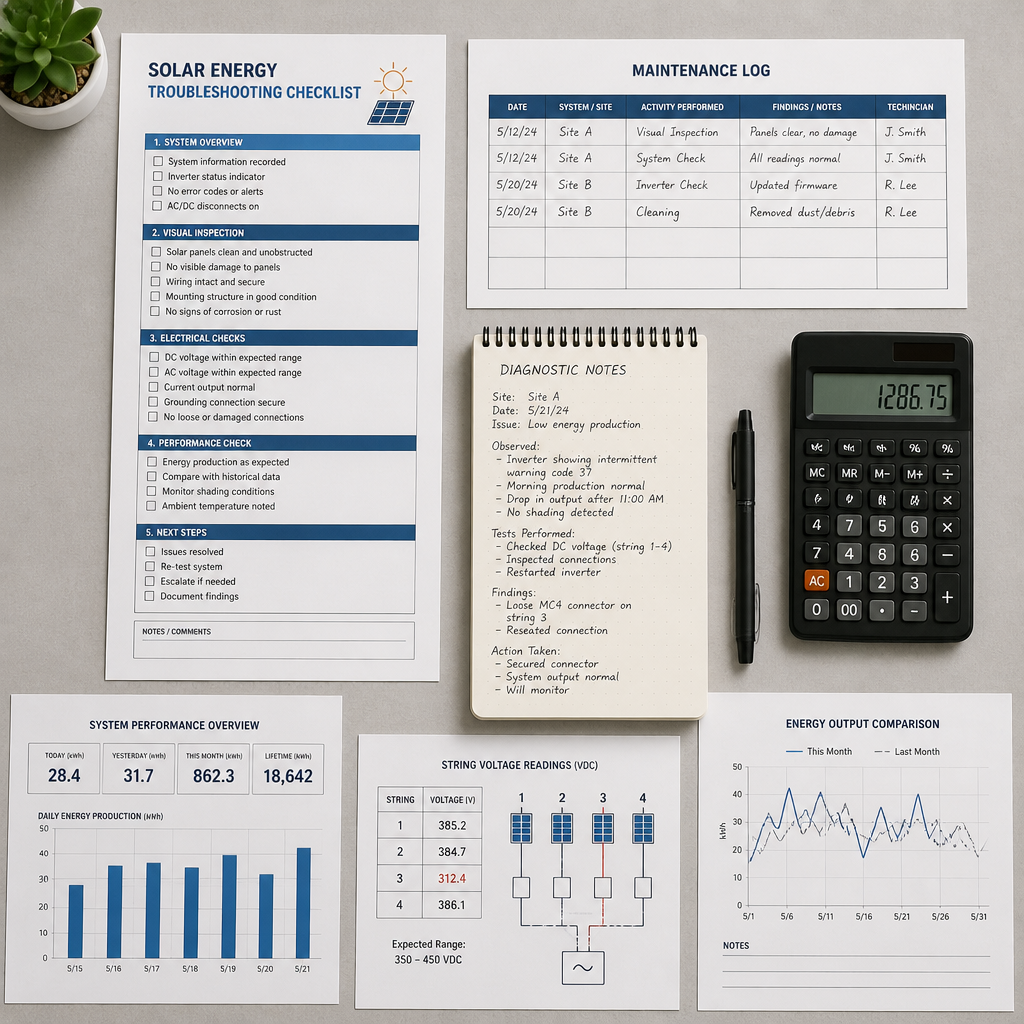
If your inverter provides string-level monitoring (many do), look for a string whose output is noticeably lower than the others during peak sun hours on a clear day. A well-matched set of panels on the same roof plane should produce similar outputs. A 20-30% gap between strings on a clear afternoon is a red flag.
What Microinverters and Power Optimizers Change
Systems equipped with microinverters or DC power optimizers at each panel allow you to see panel-level production data. If you have this capability, use it. A single panel showing significantly lower output than its neighbors on a clear day needs to be inspected. The fix might be as simple as cleaning or as involved as a panel replacement, but catching it early prevents months of compounding losses.
If your system uses a string inverter with no panel-level visibility, a licensed solar diagnostic technician can use thermal imaging or IV curve tracing to identify which panel is the culprit without a time-consuming process of elimination.
Warning Sign 3: Inverter Error Codes You Keep Dismissing
Your inverter communicates with you through error codes and status lights. Many homeowners see a fault code, notice the system seems to be running again, and move on. That is a mistake.
Intermittent error codes, particularly those related to grid connection, isolation faults, or DC input voltage, are frequently early indicators of wiring degradation, a failing inverter component, or a grounding problem. They may clear themselves temporarily while the underlying issue worsens. By the time the inverter fails completely, the problem has often been signaling for weeks or months.
Pro tip: Take a photo of every error code your inverter displays, along with the date and time. This log is invaluable for a diagnostic technician. Many fault codes are intermittent by nature, and having a documented history of when they appeared helps narrow down the root cause far faster than a single site visit without prior data.
Inverter health is closely tied to ventilation and temperature. In Mid-Atlantic summers, inverters installed in attics or on south-facing walls can experience thermal stress that accelerates component wear. If your inverter is in a hot location and you're seeing recurring faults, that context matters when scheduling a solar repair Mid-Atlantic service call.
Warning Sign 4: Visible Physical Damage You Haven't Acted On
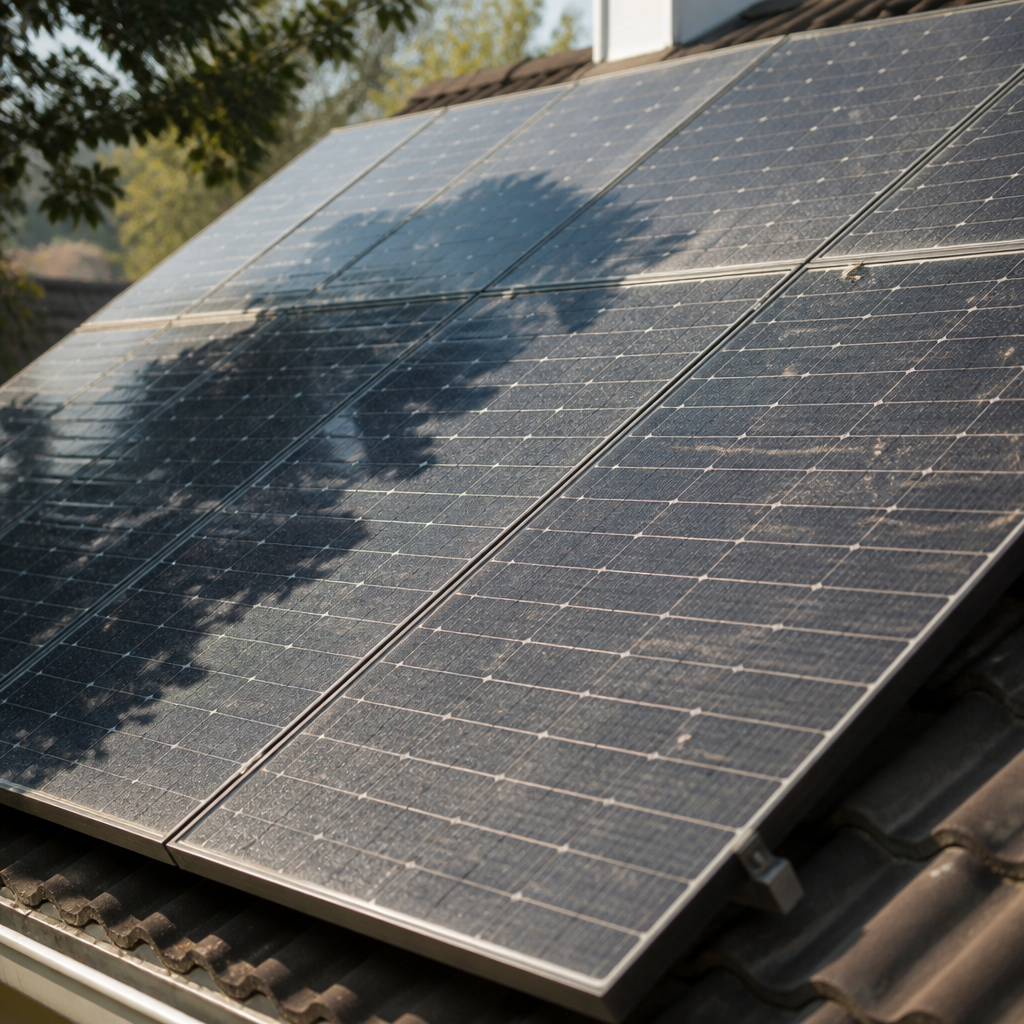
Walk around your property on a bright day and look at your panels from ground level. You don't need to get on the roof. What you're looking for: discoloration (brown or yellow patches on cells), cracked glass, delamination where the panel layers are visibly separating, or snail trail patterns, which look like brownish streaks following the silver busbars.
Any of these conditions means the panel is compromised. A cracked panel is not just an efficiency problem. Cracked glass exposes the module internals to moisture, which accelerates degradation and can create a safety hazard. Delaminated panels allow water infiltration and internal corrosion, which the U.S. Department of Energy's Operations and Maintenance resources identify as a key risk to long-term system performance.
Regular inspection of photovoltaic modules is not optional maintenance. Physical damage that goes unaddressed leads to accelerated internal corrosion and micro-cracking that shortens the working life of the affected module and stresses adjacent components in the system.
Micro-cracking from freeze-thaw cycles is particularly relevant in Pennsylvania, Maryland, and Delaware, where winter temperatures regularly fluctuate around the freezing point. This type of damage is invisible without close-up inspection or thermal imaging, but it reduces the electrical output of a panel gradually over time.
Warning Sign 5: Soiling and Shading That Wasn't There at Install
Your system was designed around the roof conditions that existed when the installer did their site assessment. Two, three, or five years later, those conditions may have changed significantly. Trees grow. New construction adds structures that cast shadows. A neighboring property adds a second story. These changes can eliminate hours of direct sunlight per day that the system was designed to capture.
The Mid-Atlantic Pollen and Debris Problem
Spring in this region brings heavy pollen loads that coat solar panels with a layer of fine dust. Fall brings leaf debris. Both reduce the amount of light reaching the solar cells. In dry regions, rain clears soiling fairly efficiently. In the Mid-Atlantic, pollen is often sticky and doesn't rinse off cleanly. Manual cleaning, at least once in spring and once in fall, is worthwhile maintenance for most residential systems in this region.
How to Check for New Shading
The most reliable method is to compare your monitoring data for the same month across multiple years. If June of this year produced noticeably less than June two years ago on similar weather days, and your panels are clean, new shading is a strong candidate. A licensed technician with shading analysis software can quantify exactly how much production you're losing and whether tree trimming or a system redesign makes financial sense.
Warning Sign 6: Battery Storage Not Charging or Discharging Correctly
If your home includes a battery storage system paired with solar, the battery adds a layer of complexity to performance monitoring that many homeowners underestimate. A battery that isn't charging to its rated capacity during the day, or isn't discharging enough power at night, is wasting a significant portion of what your solar array is producing.
Common symptoms include the battery reaching a low state of charge faster than expected during an outage, your home pulling grid power in the evening even when the battery should still have reserve capacity, or the monitoring app showing the battery stuck at a fixed state of charge for extended periods.
Battery storage systems require their own diagnostics. Cell degradation, communication errors between the battery management system and the inverter, or firmware issues can all reduce effective capacity without triggering a visible fault. Triple R Energy services and diagnoses battery storage systems alongside solar diagnostics, which matters because problems in one component often affect the other.
If you're not sure whether your battery system is performing correctly, checking the monitoring history for daily charge and discharge cycles over the past month is the right starting point. Normal operation should show a consistent pattern of charging during sun hours and discharging through the evening.
Warning Sign 7: Your Utility Bill Hasn't Changed Meaningfully
This is the simplest and most overlooked indicator. If you installed solar a year or more ago and your electricity bills don't reflect the savings your installer projected, something is wrong. Either the system is underperforming, your household energy consumption has increased significantly, or your utility billing structure has changed. All three are diagnosable.
Pull your utility bills from the year before installation and compare them month-by-month against bills from the past year. If the reduction in grid consumption is substantially smaller than the solar production your monitoring app reports, that gap points to a net metering issue, a billing error, or a system that is exporting far less energy than expected.
For homeowners in states like Maryland, Virginia, and New Jersey with established net metering programs, your utility bill should show a clear credit for energy exported to the grid. If it doesn't, or if the credit is far smaller than the production your monitoring system reports, contact your utility and your solar contractor together. This is a problem that requires both to resolve.
Pro tip: Keep a simple spreadsheet with your utility bill total, your solar production for the same month from your monitoring app, and your estimated savings from the original proposal. Reviewing this quarterly takes ten minutes and will catch a developing problem before it becomes a year of lost value.
How to Compare Your Options When Solar Panel Problems Arise
When you identify a potential solar panel problem, you have a few paths to diagnosis and repair. The right choice depends on the nature of the problem, your system's age, and whether you have an active warranty relationship with your original installer.
Option | Best For | Key Limitation |
|---|---|---|
Contact your original installer (large national company) | Systems under active warranty with a responsive service team | Large national installers like Sunrun or Sunnova can have slow service response times for existing customers, and their technicians may not be local to your area. |
Contact the equipment manufacturer directly | Warranty claims on a specific panel or inverter brand | Manufacturers handle warranty replacement, not installation or system-level diagnostics. You'll still need a licensed contractor to physically perform the repair. |
Hire an independent licensed solar service contractor | Diagnostics, repair, systems from any installer, battery storage issues, inverter problems, panel replacement | Requires vetting the contractor's license and experience. Make sure they are licensed in your state and carry appropriate insurance. |
In practice, the most common situation Mid-Atlantic homeowners face is a system installed by a national company that no longer has strong local service infrastructure. An independent licensed contractor who specializes in solar diagnostics and repair, like Triple R Energy serving Delaware, Maryland, New Jersey, Pennsylvania, Virginia, and D.C., can work on any system regardless of who installed it. That independence matters when your original installer is slow to respond or has reduced their service footprint in your area.
For solar repair Mid-Atlantic needs, always confirm that the contractor holds an active electrical contractor license in your specific state. Solar repair involves live DC electrical systems, and unlicensed work creates both safety risks and warranty complications.
Frequently Asked Questions
How much production loss is normal for a solar system over time?
Solar panels do degrade gradually over their lifetime, but the rate should be very slow, typically less than 1% per year for quality panels. If your system is losing more than that annually, or if you notice a sudden drop rather than a gradual one, that points to a specific component problem rather than normal aging. Sudden drops always warrant investigation.
Can I diagnose solar panel problems myself without getting on the roof?
You can do a meaningful first-pass diagnosis from the ground. Check your monitoring app for production data, compare against historical data and your original estimate, visually inspect panels for obvious damage or debris, and log any inverter error codes you've seen. This ground-level review will tell you whether a professional diagnostic visit is warranted. Don't get on the roof yourself. The combination of solar panels and roof pitch creates serious fall risk for untrained individuals.
My monitoring app shows normal production, but my bills are still high. What's going on?
Several things can cause this disconnect. Your household energy consumption may have increased since installation, for example from a new EV, a home addition, or a new HVAC system. Your net metering agreement may have terms that limit credit rates. Or there may be a discrepancy between what your inverter reports as production and what is actually being delivered to your home and grid. A licensed technician can check whether your monitoring system is calibrated correctly and whether your utility billing matches actual export data.
How often should a residential solar system be professionally inspected?
A professional inspection every two to three years is a reasonable baseline for a well-functioning system. After any major weather event, including hail, heavy ice accumulation, or high winds, an inspection is worth scheduling sooner. Systems with battery storage benefit from annual checkups because battery management systems have more moving parts electronically than a basic solar-plus-inverter setup.
Does Triple R Energy work on solar systems installed by other companies?
Yes. Triple R Energy is an independent licensed electrical contractor and solar service specialist. They diagnose and repair solar systems regardless of which company originally installed them, across Delaware, Maryland, New Jersey, Pennsylvania, Virginia, and Washington, D.C. This is one of the key differences between an independent service contractor and a large national installer who may only service their own equipment.
What is the first thing I should check if I think my solar system is underperforming?
Start with your monitoring data. Log into your inverter's monitoring platform and pull production data for the last 12 months. Compare it against your original production estimate from your installation contract. If you see a consistent gap of 10% or more, or if you see a sudden drop at a specific point in time, those are the two patterns that most clearly indicate a problem worth investigating further with a professional diagnostic visit.
If you've noticed any of these warning signs in your own system, share what you found in the comments or reach out directly. Real experiences from Mid-Atlantic homeowners help other readers know what to watch for in their own systems.
We would love your feedback and any insights you would share with others. What perspective would you add?