Most homeowners in Delaware, New Jersey, and Pennsylvania wait until after buying an electric vehicle to think about home charging. That is the wrong order of operations. A Level 2 EV charger installation can take anywhere from one day to several weeks depending on your panel, your municipality's permit queue, and whether your home needs an electrical upgrade first. Getting ahead of that process saves you weeks of slow, overnight charging on a standard 120-volt outlet. This guide covers everything a Mid-Atlantic homeowner needs to know: what Level 2 actually means, what it costs in this region, what rebates exist in NJ, PA, and DE, and how to pick the right installer.
Table of Contents
- What Is Level 2 Charging and Why Does It Matter?
- Electrical Requirements Before Installation Begins
- The Installation Process, Step by Step
- Cost Breakdown for DE, NJ, and PA Homeowners
- Rebates and Incentives Available in Delaware, New Jersey, and Pennsylvania
- Charger Options Compared: Plug-In vs. Hardwired
- Permits and Inspections in the Mid-Atlantic Region
- How to Choose a Qualified EV Charger Installer
- Frequently Asked Questions
- References
What Is Level 2 Charging and Why Does It Matter?
Level 1 charging uses a standard 120-volt household outlet. It adds roughly 3 to 5 miles of range per hour, which means a car with a 300-mile battery can take two full days to charge from empty. For occasional EV owners who drive short distances, that might be tolerable. For anyone commuting more than 30 miles round trip in Delaware, New Jersey, or Pennsylvania, it is a constant inconvenience.
Level 2 charging operates on a 240-volt circuit, the same voltage used by electric dryers and ranges. It delivers 20 to 40 miles of range per hour depending on the charger's amperage and the vehicle's onboard charger capacity. Most EVs go from near-empty to full overnight on a properly sized Level 2 unit. That difference in daily usability is not marginal. It changes how you interact with your car entirely.
Level 3 (DC fast charging) is not relevant to home installation. It requires commercial-grade electrical service and costs tens of thousands of dollars to install. For residential use, Level 2 is the only sensible target.
Electrical Requirements Before Installation Begins
This is where most online guides gloss over the detail that actually matters. Before anyone runs a wire or mounts a charger bracket, your home's electrical panel has to be evaluated. Skipping this step is the single most common mistake homeowners make when planning a home EV charger in NJ, PA, or DE.
Panel Capacity: The Real Starting Point
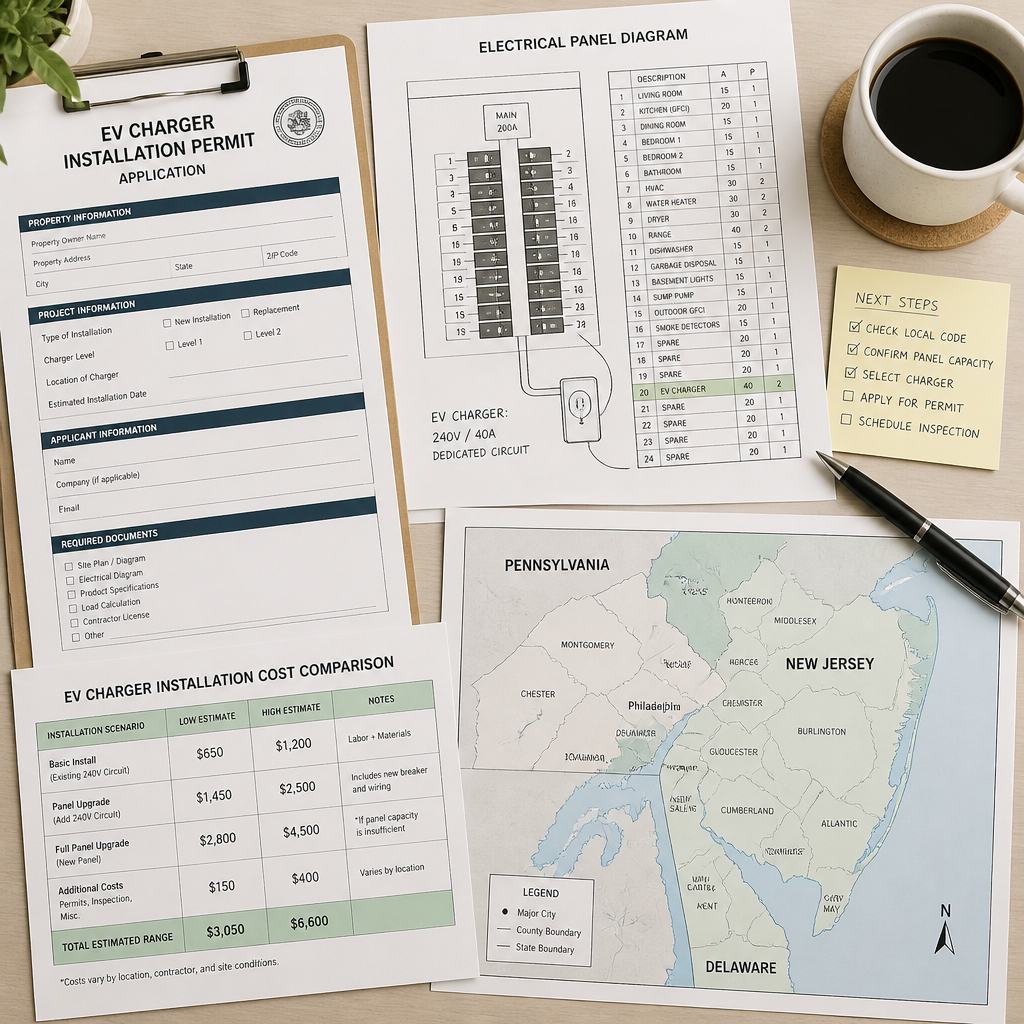
A 40-amp Level 2 charger needs a 50-amp dedicated breaker, per National Electrical Code requirements that size breakers at 125% of the charger's continuous load. A 48-amp charger needs a 60-amp breaker. If your panel is a 200-amp service, you almost certainly have enough capacity. If you are in an older Delaware or South Jersey home with a 100-amp panel, you may not, especially if you are already running central air, an electric water heater, or an electric range.
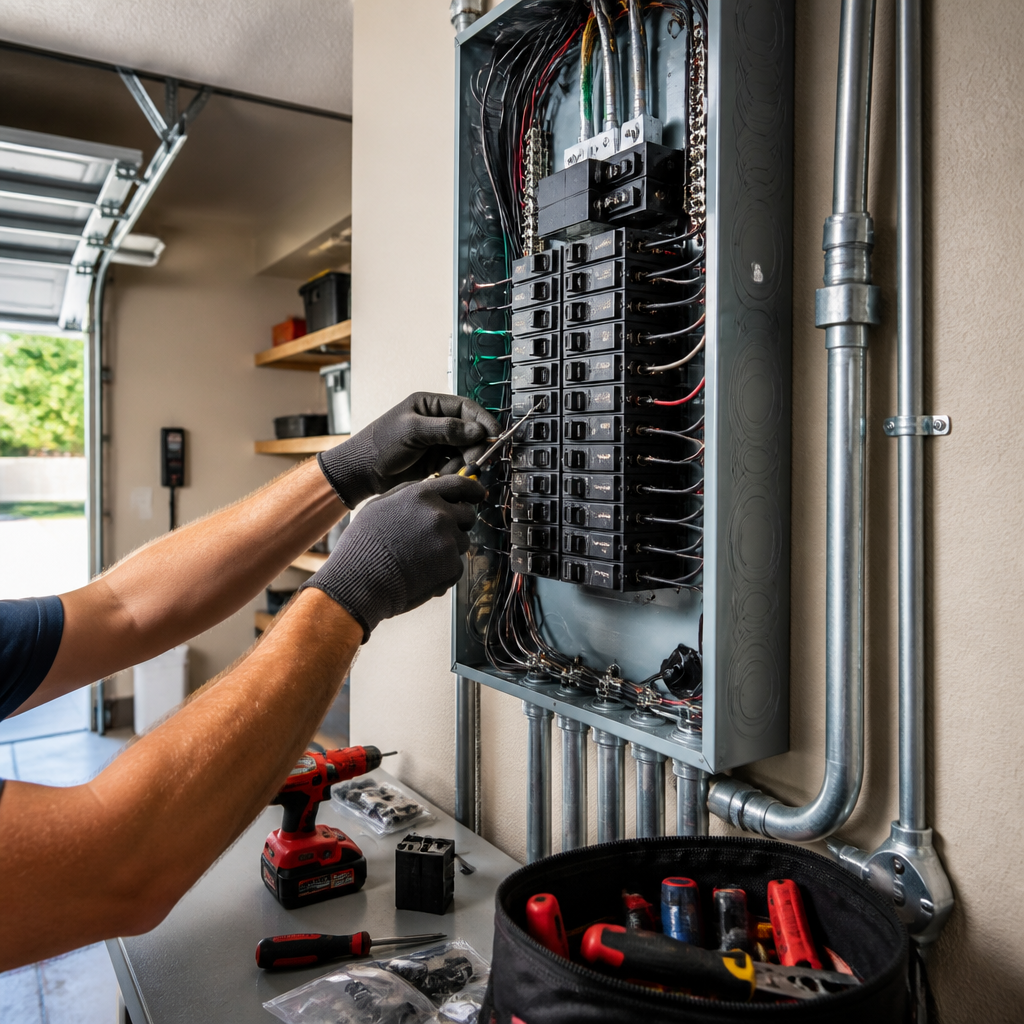
A load calculation is not optional. A licensed electrician will assess every major circuit in your home and determine whether adding a 40 to 50-amp EV circuit is safe without upgrading the panel. In practice, about one in five homes in this region requires at least a service upgrade before a Level 2 charger can be safely installed. Older row homes in Philadelphia's suburbs and pre-1980 construction in Northern Delaware are the most frequent candidates for that upgrade.
Wiring Run Length Matters
Your panel is usually in a basement, utility room, or garage. If your charger is going on an exterior wall of the garage adjacent to the panel, the wiring run is short and labor costs stay low. If your panel is at the opposite end of the house from where you park, expect a longer, more expensive conduit run. Some homeowners in Pennsylvania and New Jersey have garages detached from the main house, which introduces the need for a subpanel or a buried conduit run, both of which add cost and permit complexity.
Pro tip: Before scheduling any installer quotes, note the straight-line distance from your electrical panel to your preferred charger location. If it is over 50 feet, mention that upfront. It significantly affects both the labor estimate and whether a subpanel makes more financial sense than a direct run.
The Installation Process, Step by Step
A straightforward Level 2 EV charger installation in a home with adequate panel capacity, a nearby garage, and no subpanel requirement typically takes four to six hours of labor. Here is what that process actually looks like in practice, not in theory.
Step 1: Site Assessment and Load Calculation
A qualified electrician visits your home, inspects the panel, identifies the optimal charger location, maps the wiring route, and confirms whether the existing service can handle the new circuit. This usually takes 30 to 60 minutes. Some contractors include this in a free quote; others charge a small assessment fee that is credited toward the job.
Step 2: Permit Application
In Delaware, New Jersey, and Pennsylvania, electrical permits are required for EV charger installations. Your electrician pulls the permit from the local municipality. Permit fees in this region typically run between $75 and $300 depending on the jurisdiction. Processing times vary. Some municipalities in Pennsylvania issue permits same-day. Others in New Jersey can take two to three weeks, which is why starting this process early matters.
Step 3: Circuit Installation and Charger Mounting
The electrician installs the dedicated circuit from your panel to the charger location, mounts the EVSE unit, and connects all wiring. For a hardwired unit, the charger is connected directly to the panel. For a plug-in unit, a NEMA 14-50 receptacle is installed first. The charger is then mounted at the appropriate height and angle for your vehicle's charge port location.
Step 4: Inspection and Sign-Off
After installation, a municipal inspector verifies the work meets local electrical code. In most Mid-Atlantic jurisdictions, this inspection is not optional. Your installation is not code-compliant until it passes. A reputable installer schedules this on your behalf and is present for the inspection. Once the inspector signs off, your charger is fully legal and warrantiable.
Pro tip: Ask your installer for a copy of the final inspection approval document. You will need it if you ever sell the home, file for a utility rebate, or make an insurance claim related to the charger.
Cost Breakdown for DE, NJ, and PA Homeowners
Total costs for a Level 2 EV charger installation in the Mid-Atlantic region vary depending on whether your panel needs upgrading, how long the wiring run is, and which charger unit you choose. Here is a realistic range for each major cost component, based on current regional market conditions.
The EVSE unit itself, meaning the wall-mounted charger, runs from roughly $300 to $900 for a quality residential unit. Labor for a straightforward installation with no panel work ranges from $300 to $700. Permits add $75 to $300 depending on your municipality. If you need a panel upgrade, that adds $1,500 to $4,000 or more depending on service size and complexity. A detached garage subpanel runs another $800 to $1,500 on top of that.
For a homeowner with a modern 200-amp panel and an attached garage, total installed cost, charger included, typically lands between $800 and $1,800. For a homeowner needing a panel upgrade, expect $2,500 to $5,000 or higher. These figures are consistent with what homeowners in the Philadelphia suburbs, central New Jersey, and the Wilmington area have been paying.
The panel, not the charger, is almost always the deciding factor in what a home EV charging installation actually costs. Knowing your panel's age and capacity before you get quotes puts you in a much stronger negotiating position.
Rebates and Incentives Available in Delaware, New Jersey, and Pennsylvania
Homeowners in all three states have access to financial incentives that meaningfully reduce installation costs. The programs differ by state and, in some cases, by utility provider. Here is the current picture for each state in this region.
New Jersey
New Jersey's Charge Up NJ program offers a $250 rebate for the purchase and installation of an eligible Level 2 EV charger for homeowners. Atlantic City Electric (ACE) offers additional rebates of up to $1,000 for residential customers installing new Level 2 chargers. Jersey Central Power & Light (JCP&L) offers up to $7,000 in incentives for eligible customers, including up to $1,500 for customer electrical upgrades.
Pennsylvania
Pennsylvania utility incentives vary by provider. Adams Electric Cooperative offers a $300 bill credit for homeowners who install a Level 2 charger connected to a utility-controlled subpanel. Central Electric Cooperative offers a $100 rebate for residential Level 2 installations. PECO also offers rebates for eligible residential customers, though the primary PECO rebate programs are currently structured around commercial and public charging.
Delaware
Delaware homeowners should check with Delmarva Power and local municipality programs, as state-level EV incentive programs in Delaware are less centralized than in New Jersey. The federal 30C Alternative Fuel Vehicle Refueling Property Tax Credit is available in all three states and is the most broadly applicable incentive for Delaware residents.
Federal 30C Tax Credit
The federal 30C tax credit covers up to 30% of installation costs, capped at $1,000 for residential use, for homeowners in qualifying low-income or rural census tracts. This credit was reauthorized by the Inflation Reduction Act and applies to chargers installed and operational by June 30, 2026. Check the IRS eligibility map to confirm whether your address qualifies before assuming this credit applies to you.
Charger Options Compared: Plug-In vs. Hardwired
One of the most common questions during a home EV charger consultation is whether to install a plug-in unit via a NEMA 14-50 outlet or have the charger hardwired directly to the panel. Both approaches work, but they are not equivalent. Here is how they compare in practice for homeowners in this region.
Feature | Plug-In (NEMA 14-50) | Hardwired |
|---|---|---|
Max amperage | Up to 40 amps | Up to 48 amps or higher |
Installation complexity | Lower, outlet is the main work | Higher, direct panel connection |
Portability | Charger can be unplugged and moved | Fixed to the wall permanently |
GFCI requirement | Many jurisdictions now require GFCI on NEMA 14-50 outlets, which can conflict with charger's built-in GFCI | No separate GFCI required |
Long-term reliability | Plug connection can loosen over repeated cycles | More stable, lower maintenance risk |
Best for | Renters, homeowners who may relocate soon | Long-term homeowners, higher-amperage needs |
For most homeowners in Delaware, New Jersey, and Pennsylvania who plan to stay in their home for more than three years, hardwiring is the better choice. It eliminates the nuisance-tripping issue that affects many plug-in installations, supports higher charging speeds, and does not require the GFCI workaround that some local codes now impose on NEMA 14-50 outlets.
Permits and Inspections in the Mid-Atlantic Region
Some homeowners push back on the permit requirement, viewing it as unnecessary paperwork and added cost. That is a short-sighted position. An unpermitted EV charger installation can void your homeowner's insurance coverage for any fire or electrical damage related to the charger. It can also create legal complications when selling the home, since buyers' inspectors and attorneys routinely flag unpermitted electrical work.
In New Jersey, the Board of Public Utilities specifically states that EV charger installations should be performed by licensed electricians and permits are required by local building departments. Pennsylvania municipalities uniformly require electrical permits for any new circuit installation. Delaware follows the National Electrical Code, and local jurisdictions enforce permit requirements for EV charger work.
The practical implication: always use a licensed electrical contractor who pulls permits as a standard part of the job. If an installer offers to skip the permit to save you money, walk away. That is not a deal. That is a liability.
How to Choose a Qualified EV Charger Installer
The EV charger installation market has attracted a wave of general handymen, unlicensed contractors, and solar companies that treat EV charging as an add-on service they are not actually specialized in. Choosing the wrong installer is the fastest way to end up with a code violation, a denied rebate, or a charger that underperforms because the circuit was sized incorrectly.
What to Look for in a Home EV Charger Installer
First, verify the contractor holds an active electrical license in the state where your home is located. Delaware, New Jersey, and Pennsylvania all have online license verification tools through their respective state licensing boards. A solar company or general contractor should not be doing electrical work unless they employ licensed electricians on staff, not just as subcontractors brought in after the sale.
Second, confirm the installer has experience specifically with EV charger installations and panel work, not just general residential electrical. Ask how many EV charger installations they have completed and whether they have done work in your specific municipality. Local experience matters because permit timelines, inspector expectations, and code interpretations vary by jurisdiction across DE, NJ, and PA.
Third, get three written quotes and compare them line by line: equipment, labor, permit fees, and any panel or wiring work. A quote that seems low often excludes permit fees or assumes no panel work, which surfaces as an expensive surprise later. A reputable installer tells you upfront what the panel assessment found and what, if anything, needs upgrading before the charger goes in.
Triple R Energy is a licensed electrical contractor serving Delaware, Maryland, New Jersey, Pennsylvania, Virginia, and Washington, D.C., with direct expertise in EV charger installation, panel upgrades, and battery storage. Unlike large national solar companies that treat EV charging as an afterthought, Triple R focuses on the full residential electrical picture, which means your charger gets sized correctly the first time, the permit gets pulled properly, and the installation passes inspection without a callback. Learn more about Triple R Energy's EV charger installation services.
Frequently Asked Questions
How long does a Level 2 EV charger installation take?
For a home with adequate panel capacity and an attached garage, a standard installation takes four to six hours of labor on the day of the appointment. Factor in permit processing time, which ranges from same-day in some Pennsylvania municipalities to two to three weeks in certain New Jersey jurisdictions. Total timeline from first call to completed inspection is typically one to three weeks.
Do I need a panel upgrade to install a Level 2 charger in New Jersey or Pennsylvania?
Not always. Homes with a 200-amp electrical service and available breaker slots usually do not need a panel upgrade. Older homes with 100-amp or smaller panels may need an upgrade, especially if they already have high-draw appliances like electric ranges, heat pumps, or electric water heaters. A licensed electrician needs to perform a load calculation to confirm this. Do not assume either way without that assessment.
What rebates are available for home EV charger installation in New Jersey?
New Jersey's Charge Up NJ program provides a $250 rebate for purchasing and installing a qualifying Level 2 EV charger at home. Atlantic City Electric customers may qualify for up to $1,000, and JCP&L customers may qualify for up to $7,000 in incentives including electrical upgrade costs. Eligibility requirements and funding availability change, so check current program status directly with your utility before counting on any specific amount.
What is the difference between a Level 2 charger and a home EV charging station?
These terms refer to the same thing. A Level 2 EV charger, also called an EVSE (Electric Vehicle Supply Equipment) or home charging station, is a wall-mounted unit that delivers 240-volt AC power to your vehicle. The unit itself does not store energy. It manages the connection between your home's electrical system and your car's onboard charging system. Level 2 is the designation for 240-volt home and commercial AC charging, as opposed to Level 1 (120V) or Level 3 (DC fast charging).
Can I install a Level 2 EV charger in a detached garage in Pennsylvania or Delaware?
Yes, but it adds complexity. A detached garage requires either a long conduit run from your main panel or a dedicated subpanel in the garage. Both approaches require permits and professional installation. If the garage is more than 50 to 75 feet from the main panel, a subpanel is often the more cost-effective and code-compliant solution. A licensed electrician can assess your specific property layout and recommend the right approach.
Will a Level 2 EV charger add to my home's resale value?
A properly permitted and inspected Level 2 EV charger installation is considered a desirable home feature in the Mid-Atlantic market, particularly as EV ownership rates climb in Delaware, New Jersey, and Pennsylvania. The underlying electrical work, including any panel upgrades, adds measurable value regardless of the charger. An unpermitted installation, by contrast, can actually complicate a sale if flagged during buyer inspection.
Have you recently gone through the EV charger installation process in Delaware, New Jersey, or Pennsylvania? Share what surprised you most, whether it was the permit timeline, the panel assessment, or something else entirely.
References
Level 2 EV charger installation costs in Philadelphia and New Jersey, with permit and rebate details
Level 2 EV charger installation electrical requirements, panel capacity, and hardwiring guidance
Federal 30C Alternative Fuel Vehicle Refueling Property Tax Credit details and eligibility
New Jersey EV charger rebates and utility incentive programs for homeowners
Pennsylvania EV charger rebates and utility incentive programs by provider