Power outages in Maryland are not a rarity. Between summer thunderstorms rolling through the Chesapeake corridor, nor'easters that can knock BGE and Pepco customers offline for days, and the occasional grid-level transmission failure, homeowners with rooftop solar are discovering an uncomfortable truth: solar panels alone go dark the moment the grid does. That is the core reason battery backup in Maryland is no longer a luxury item on a spec sheet. It is a practical decision that more Mid-Atlantic homeowners make every year, and the financial case for it has become substantially stronger thanks to stacked state and federal incentives that were not available even a few years ago.
Table of Contents
- Quick Takeaways
- Why Solar Alone Is Not Enough in Maryland
- Maryland Incentives That Change the Math
- What a Home Battery System Actually Does for You
- Comparing Your Battery Storage Options
- How BGE and Pepco Time-of-Use Rates Make Storage Pay Off
- Common Mistakes Maryland Homeowners Make When Adding Storage
- Frequently Asked Questions
- References
Quick Takeaways
Key Insight | Explanation |
|---|---|
Solar panels shut off during grid outages without a battery | Most grid-tied inverters have an anti-islanding shutoff. Without a battery, your solar system cannot power your home during a blackout, even on a sunny day. |
Maryland's RCES Grant covers up to $5,000 for residential storage | The Residential and Commercial Energy Storage (RCES) Program provides a grant equal to 30% of installed battery costs, capped at $5,000. You must receive a Reservation Certificate from MEA before installation begins. |
The federal Residential Clean Energy Credit adds another 30% | This federal tax credit applies to both solar panels and battery storage with no cap, stacking directly on top of the Maryland state grant for significant total savings. |
Battery storage can achieve 60 to 80 percent grid independence | For most Maryland homeowners already on solar, adding storage lets them use their own production during peak evening hours instead of buying back from the grid at higher rates. |
BGE and Pepco have expanded time-of-use rate structures | Pairing a battery with solar is increasingly valuable as utilities shift customers to plans where evening energy rates are higher. A battery charged during the day saves money every night. |
Solar equipment is exempt from Maryland's sales tax | Maryland exempts solar equipment and installation from the state's roughly 6% sales tax, reducing the upfront cost of every battery system installed. |
RCES FY26 funding is limited and first-come, first-served | The FY26 RCES program carries a $2 million budget with applications open until June 5, 2026 or until funds are exhausted. Waiting has a real cost in Maryland. |
Why Solar Alone Is Not Enough in Maryland
Here is something most solar salespeople do not emphasize upfront: a standard grid-tied solar system is designed to shut off automatically the moment utility power goes out. This is not a malfunction. It is a deliberate safety requirement called anti-islanding protection, built in to prevent your panels from sending power into lines that utility crews may be working on. The result is that your panels sit idle during the exact storm when you need them most.
Maryland's weather makes this a recurring problem, not a theoretical one. Severe summer thunderstorms regularly knock out power to thousands of BGE customers in the Baltimore area and Pepco customers closer to the D.C. line. The grid has become more resilient through infrastructure upgrades, but outages still happen, and they rarely arrive at a convenient time. For homeowners with medical equipment, home offices, or young children, a multi-hour outage during a heat wave is not merely an inconvenience.
Adding a battery changes the equation entirely. A battery-backed solar system with the right inverter configuration creates a protected circuit in your home that stays live during a grid outage, drawing from stored solar energy or directly from the panels when conditions allow. You are no longer dependent on when the utility restores service.
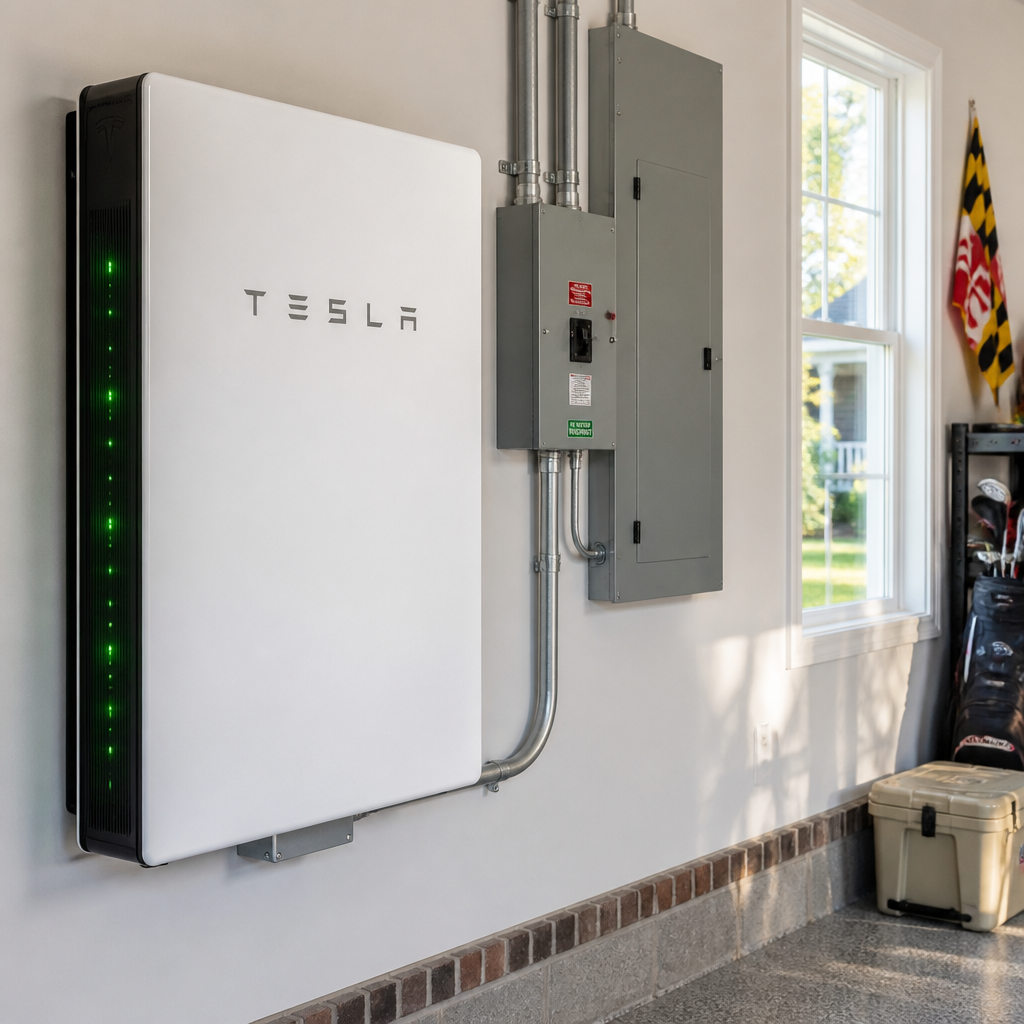
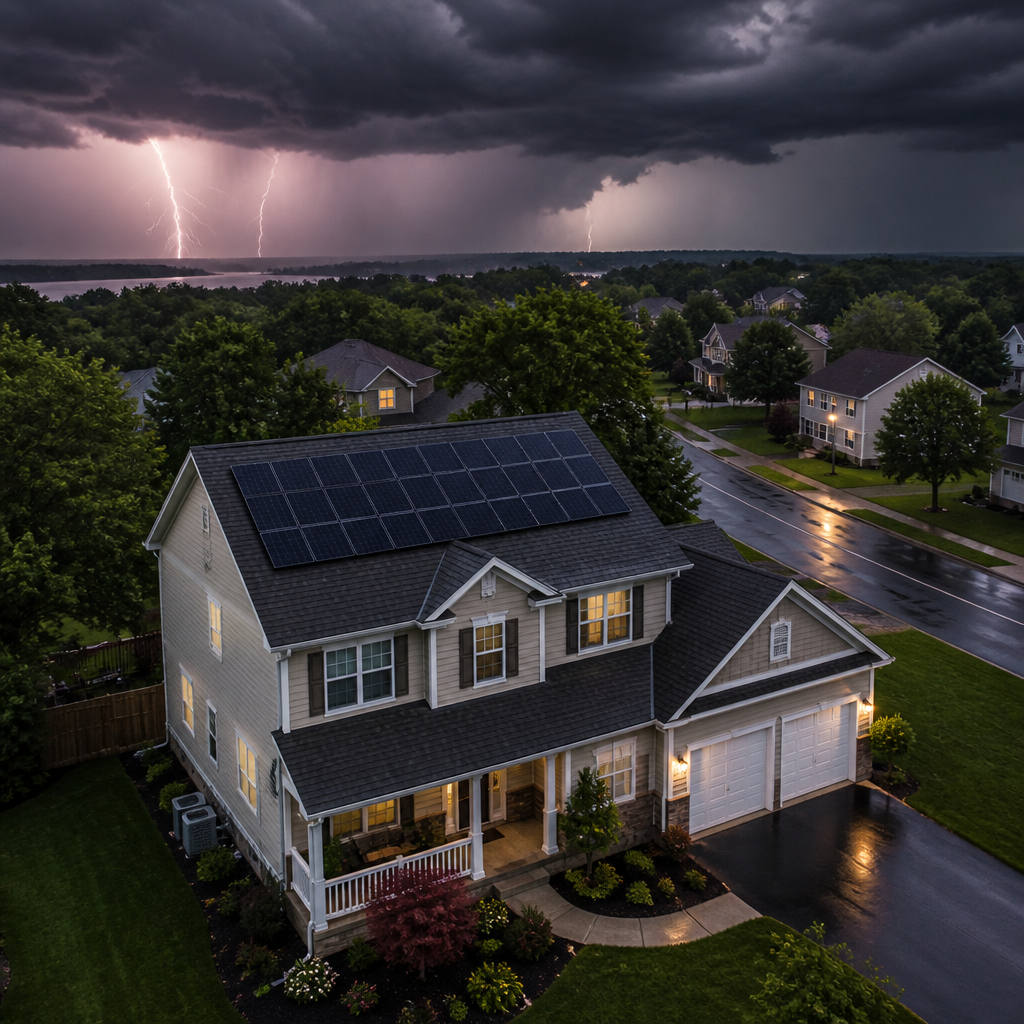
In practice, the best systems for Maryland homes use an automatic transfer switch or a hybrid inverter that detects the grid outage within milliseconds and switches to battery power without you touching anything. This is a detail worth asking about specifically when you get quotes, because not all battery installations include this level of automation.
Pro tip: Before signing any battery contract, confirm whether the proposed inverter supports "whole-home backup" or only a "critical loads panel." A critical loads panel protects only specific circuits like the refrigerator and a few outlets, while whole-home backup keeps your HVAC, sump pump, and EV charger running too. The difference matters enormously during a Maryland winter or summer storm.
Maryland Incentives That Change the Math
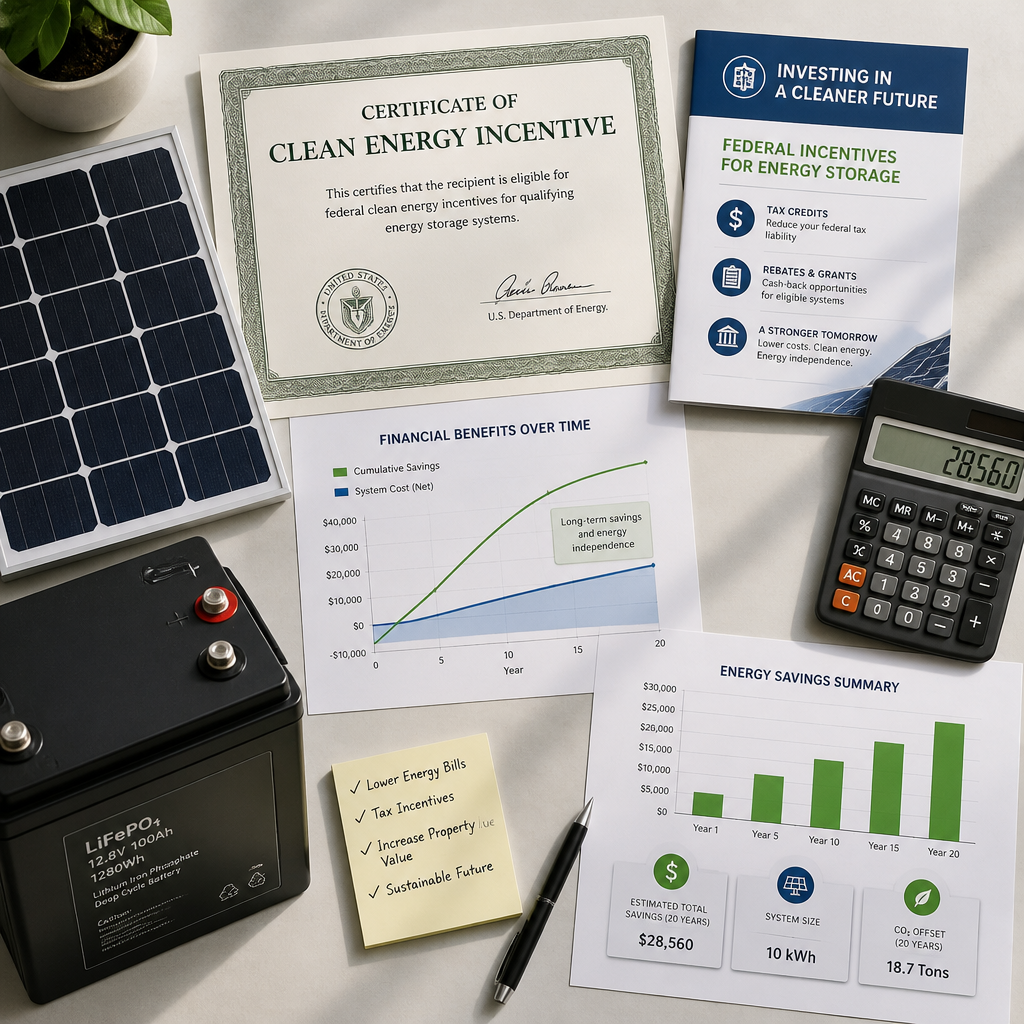
The financial case for solar battery storage in MD has never been stronger than it is right now, primarily because multiple incentive layers can be combined in a way that was not possible just a few years ago. Understanding how they stack is critical, because each program has its own application process, timing requirements, and funding limits.
The Maryland RCES Grant Program
The Maryland Energy Administration's Residential and Commercial Energy Storage (RCES) Grant Program is the direct successor to the Maryland Energy Storage Income Tax Credit, which ended in December 2024. The RCES Program provides a grant equal to 30% of your total installed battery costs, capped at $5,000 for residential installations. The FY26 program launched with a $2 million budget and accepts applications on a first-come, first-served basis until June 5, 2026, or until funds run out. Critically, you must receive a Reservation Certificate from MEA through the MyMEA portal before installation begins. Scheduling your contractor and then applying after the fact will disqualify you from this grant.
Maryland Sales Tax Exemption
Solar equipment and installation remain exempt from Maryland's approximately 6% sales tax. On a battery system that costs $10,000 before incentives, that exemption alone saves around $600 without any additional paperwork on your part.
The incentive stack available to Maryland homeowners makes battery storage considerably more manageable than the sticker price suggests. The 30% federal Residential Clean Energy Credit applies to both solar panels and battery storage, reducing your total system cost directly, and Maryland homeowners have additional state-level programs through the Maryland Energy Administration that provide direct financial support for residential energy storage.
Pro tip: Apply for the Maryland RCES Reservation Certificate before you finalize your installation date. Contractors who are familiar with MEA's process will guide you through this sequencing, but contractors who are new to Maryland's incentive programs may not. Ask specifically: "Will you help me secure my MEA Reservation Certificate before we schedule installation?"
What a Home Battery System Actually Does for You
A home battery system in Maryland serves three distinct functions, and most homeowners focus only on one of them when making their purchasing decision. Understanding all three helps you size the system correctly and choose the right battery chemistry and configuration.
Backup Power During Outages
This is the most obvious use case and the one that typically closes the sale. A fully charged battery can keep critical loads running for hours or even a full day, depending on what you have connected and how much capacity the battery holds. For a Maryland home with a modest critical loads setup, a single 10 kWh battery gets most families through an overnight outage without disruption. For whole-home backup that includes a central air system, a sump pump, and EV charging, you are likely looking at multiple batteries or a larger-format system. The Mid-Atlantic's humid summers mean AC is not a luxury during extended outages, and managing those loads may require stacking multiple battery units or adding a soft-start kit that reduces the startup surge your HVAC system draws.
Solar Self-Consumption and Grid Independence
Your solar panels produce the most power in the middle of the day, when household consumption is typically at its lowest. Without a battery, that excess production is exported to the grid, often at a rate lower than what you pay to buy power back in the evening. A battery stores that midday surplus and dispatches it when your household actually needs it, reducing the amount of expensive grid power you consume. For most Maryland solar homeowners who add storage, this translates to 60 to 80 percent grid independence, meaning the vast majority of the power flowing through their home comes from their own system.
Time-of-Use Rate Optimization
BGE and Pepco have expanded time-of-use rate structures, where electricity is priced higher during peak demand windows, typically evening hours. A battery charged during off-peak solar production hours and discharged during on-peak evening hours reduces the amount of high-cost grid power you consume. Over the life of the system, this load-shifting behavior compounds into meaningful savings on your utility bills, separate from and in addition to your solar production savings.
Comparing Your Battery Storage Options
Not all battery systems are created equal, and the choice matters for a Maryland home. The three most commonly installed residential battery options have meaningfully different characteristics in terms of capacity, chemistry, compatibility, and warranty structure. Here is a direct comparison of the options your installer is most likely to recommend.
Battery System | Usable Capacity | Best For |
|---|---|---|
Tesla Powerwall 3 | 13.5 kWh per unit | Whole-home backup with integrated solar inverter functionality. Strong app-based monitoring. Works best with Tesla-native installations but can pair with third-party solar arrays in most configurations. |
Enphase IQ Battery 5P | 5 kWh per unit (stackable) | Homeowners who want modular, scalable storage. Pairs naturally with Enphase microinverter systems. The microinverter-level architecture means the system continues functioning even if one unit has an issue. |
Franklin WH Series | 13.6 kWh per unit | A strong alternative for homeowners who want competitive pricing and solid backup capacity. Compatible with a broad range of inverter brands, making it useful for retrofitting existing solar systems. |
In practice, the right battery for a given Maryland home depends as much on your existing solar inverter brand as it does on the battery specs themselves. A licensed electrical contractor who handles solar diagnostics and installations, not just new solar sales, will assess your existing system and tell you which battery integrates cleanly rather than selling you whatever carries the highest margin.
How BGE and Pepco Time-of-Use Rates Make Storage Pay Off
Time-of-use billing is becoming more common for Maryland utility customers, and the financial logic of pairing storage with solar becomes clearer once you understand how it works. Under a time-of-use rate plan, the price you pay per kilowatt-hour varies depending on when you use it. Peak hours, typically evening windows when everyone comes home and turns on appliances and air conditioning, carry higher rates. Off-peak hours, including the midday window when solar panels are most productive, carry lower rates.
Without a battery, a solar homeowner might send excess midday production to the grid at the lower export rate and then buy that same power back at the higher evening rate. With a battery, you capture midday surplus, store it, and consume it in the evening when the grid rate would be highest. The battery essentially arbitrages the rate difference on your behalf every day.
Under Maryland's Climate Solutions Now Act, the state has committed to a 100% clean energy grid by 2035. BGE has been modernizing infrastructure specifically to better integrate battery storage and renewable generation as part of that transition. This means time-of-use structures are likely to expand, not contract, in the coming years, making battery storage increasingly valuable over the life of a system installed today.
Pro tip: Ask your utility about available time-of-use rate plans before your battery system is activated. In some cases, switching to the right rate plan before the battery goes live can meaningfully improve your first-year savings, and some contractors who do not specialize in Maryland specifically may not flag this step during onboarding.
Common Mistakes Maryland Homeowners Make When Adding Storage
The demand for battery storage has grown faster than the pool of contractors who truly understand how to install it correctly in a Maryland home. These are the most common mistakes that cost homeowners either money or performance.
Applying for the RCES Grant After Installation
This is the single most expensive mistake a Maryland homeowner can make in the current incentive environment. The RCES Program requires that you receive a Reservation Certificate from the Maryland Energy Administration before installation begins. Homeowners who schedule and complete their battery installation before applying forfeit the state grant entirely, typically losing up to $5,000. The application process through the MyMEA portal is not complicated, but the sequencing is rigid.
Undersizing the Battery for Actual Load
A single 10 kWh battery sounds substantial until you calculate what your home actually draws during an outage. A central air conditioner can pull 3 to 5 kWh per hour of operation. A sump pump during a rainstorm adds significant load on top of that. Homeowners who size their battery for "normal overnight use" often find it depleted by mid-morning of the second outage day. The right approach is a load analysis before specifying the battery size, not after the quote is already written.
Hiring a Contractor Without Solar Diagnostics Experience
Adding a battery to an existing solar array requires a contractor who understands how your existing inverter and panels are performing, not just how to mount a new battery enclosure on the wall. A contractor who specializes only in new installations may not identify an existing inverter that is failing or a configuration that will cause compatibility problems with the new battery. This is where choosing a solar service specialist with diagnostic capability, rather than a pure-play solar sales company, makes a practical difference.
Ignoring Electrical Panel Capacity
Many Maryland homes, particularly those built before 1990, have electrical panels that were not designed to support a modern solar-plus-storage system alongside an EV charger. Installing a battery without assessing the panel can result in an undersized service that trips regularly or fails inspection. A panel upgrade or service upgrade may need to be scoped into the project from the beginning. Contractors who are also licensed electrical contractors will catch this during site assessment. Contractors who subcontract electrical work may not.
Frequently Asked Questions
Will a battery backup system work during a power outage even on a cloudy day?
Yes, within the limits of stored capacity. A fully charged battery will power your home regardless of current weather conditions, drawing from what was stored before the outage. If the outage extends into a second or third day with continued cloud cover, your battery may deplete faster than it recharges from the panels. This is one reason that accurate load analysis and appropriate system sizing matter more than picking the most recognizable brand name on a battery enclosure.
Can I add a battery to my existing solar system in Maryland, or do I need to start over?
In most cases, yes, you can retrofit a battery to an existing solar system, but compatibility depends on your current inverter. String inverter systems often require either a battery-compatible inverter replacement or an AC-coupled battery that works alongside the existing inverter. Microinverter systems have their own pairing requirements. A contractor with solar diagnostics experience will assess your current configuration before recommending a specific battery product, rather than quoting one-size-fits-all.
How long does a home battery system last in Maryland's climate?
Most residential lithium iron phosphate (LFP) batteries carry warranties of 10 years and are designed to retain a meaningful percentage of their original capacity through the warranty period. Maryland's climate, with hot humid summers and cold winters, does not present unusual challenges for properly installed battery systems. The key is proper installation: batteries stored in conditioned or temperature-regulated spaces perform better over the long term than those installed in unconditioned garages or exposed to direct sunlight.
Does the Maryland RCES grant apply if I am only adding a battery without new solar panels?
Yes. The RCES Grant Program applies to battery storage installations whether or not they are paired with new solar panel installation. Homeowners who already have an existing solar array and want to add storage qualify for the grant on the battery portion of the project. The key eligibility requirement is that you secure your Reservation Certificate from MEA before the installation date, not that you are a new solar customer.
What is the difference between a critical loads panel setup and whole-home backup?
A critical loads panel isolates a small number of designated circuits, typically your refrigerator, a few outlets, and perhaps your Wi-Fi router, and keeps those running during an outage. Everything else in the house loses power along with the grid. Whole-home backup keeps all circuits operational, including your HVAC system, sump pump, EV charger, and appliances. The right choice depends on your priorities and your battery capacity. For most Maryland families, whole-home backup requires either a larger battery system or multiple units, but it is the configuration that most closely matches what homeowners expect when they hear "backup power."
Does Triple R Energy serve all Maryland counties?
Triple R Energy is a licensed electrical contractor and solar service specialist serving Delaware, Maryland, New Jersey, Pennsylvania, Virginia, and Washington, D.C. Whether you are a BGE customer in Baltimore County, a Pepco customer in Montgomery County, or a Delmarva Power customer on the Eastern Shore, the service area covers Maryland's primary utility territories. The team handles solar diagnostics and repairs, battery storage installation, EV charger installation, and electrical panel upgrades, so the battery assessment and any necessary panel work can be scoped and executed by the same contractor.
If you have already added battery backup to your Maryland home or are in the middle of evaluating your options, share what has worked well or what surprised you about the process in the comments below.
We would love your feedback and any insights you would share with others. What perspective would you add?