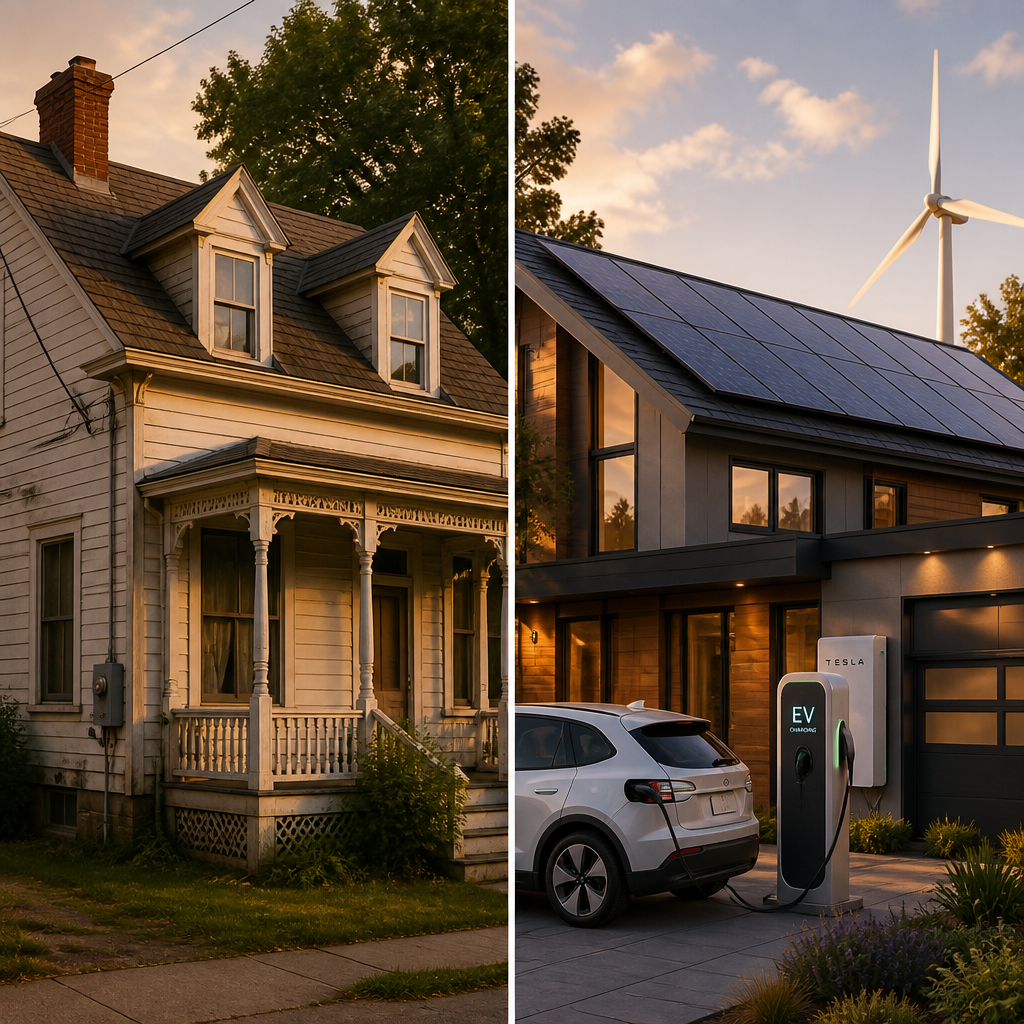
Older homes throughout Delaware, Maryland, New Jersey, Pennsylvania, Virginia, and Washington, D.C. were designed for a fraction of the electrical demand that modern households now require. A 60-amp or 100-amp service panel that once handled a few lights and a refrigerator is no longer adequate when a homeowner adds rooftop solar, an EV charger, and a battery storage system. A 200A panel upgrade for solar and EV applications resolves this gap at the source, replacing outdated service equipment with infrastructure rated for current and future electrical loads. Understanding what this upgrade involves, what it costs, and when it is required helps homeowners make decisions that are both safe and financially sound.
Table of Contents
- Quick Takeaways
- Why Older Panels Fall Short of Modern Demands
- What a 200-Amp Panel Upgrade Actually Involves
- How a 200-Amp Panel Supports Solar System Connection
- Electrical Panel Requirements for EV Charger Installation
- Battery Storage, Heat Pumps, and Other Growing Loads
- Comparing Panel Upgrade Scenarios: Which Applies to Your Home
- What to Expect from the Panel Upgrade Process
- Frequently Asked Questions
- References
Quick Takeaways
Key Insight | Explanation |
|---|---|
200-amp service is now the residential minimum standard | A 200-amp panel delivers a theoretical maximum of 48,000 watts (200A x 240V), roughly double what a 100-amp service provides, making it the baseline for homes with solar, EV chargers, or heat pumps. |
The NEC 120% Rule governs solar backfeed | The National Electrical Code restricts how much solar inverter output can be backfed into a panel relative to the main breaker rating. A 200-amp panel gives the busbar capacity needed to satisfy this requirement in most residential solar installations. |
Level 2 EV chargers require a dedicated 240V circuit | A Level 2 charger typically draws 40 to 50 amps continuously. Homes still on 100-amp service rarely have the spare capacity to add this circuit without overloading the system. |
Permits, utility coordination, and inspection are mandatory | A panel upgrade is not a DIY project. It requires building permits, a utility disconnect and reconnect, and a final inspection before power is restored. A licensed electrician manages all of these steps. |
Upgrading now avoids a second mobilization later | Homeowners who upgrade the panel during initial solar or EV charger installation avoid the added cost and disruption of returning later when battery storage or a second EV is added. |
AFCI and surge protection are included in modern panels | New 200-amp panels ship with Arc-Fault Circuit Interrupter protection and whole-house surge suppression that older equipment lacks, reducing fire risk and protecting connected electronics. |
Cost range for a 200-amp upgrade varies by scope | Industry data places the cost of a 200-amp panel upgrade in the range of roughly $1,300 to $7,350, depending on whether the project is a simple panel swap or a full service upgrade with new metering, conductors, and grounding. |
Why Older Panels Fall Short of Modern Demands
A home built before 1990 was typically wired for 60-amp or 100-amp service. That capacity was engineered for an era of incandescent lighting, a single-car garage, and appliances that drew a fraction of what modern equipment consumes. The electrical landscape of a Mid-Atlantic home in the mid-2020s looks fundamentally different: heat pump water heaters, induction ranges, smart home systems, home offices, and now electric vehicles and rooftop solar all compete for capacity within the same panel.
When load demand approaches or exceeds panel capacity, the symptoms are predictable. Breakers trip without obvious cause, lights flicker when a large appliance cycles on, and adding any new high-draw circuit becomes impractical. More critically, an overloaded panel creates genuine fire risk, particularly in homes with older wiring that has not been updated alongside the panel itself.
The 200-amp threshold is not arbitrary. It reflects the point at which a residential service can reasonably accommodate both baseline household consumption and the dedicated circuits required for solar interconnection, EV charging, and battery storage without operating near its rated limit at all times.
What a 200-Amp Panel Upgrade Actually Involves
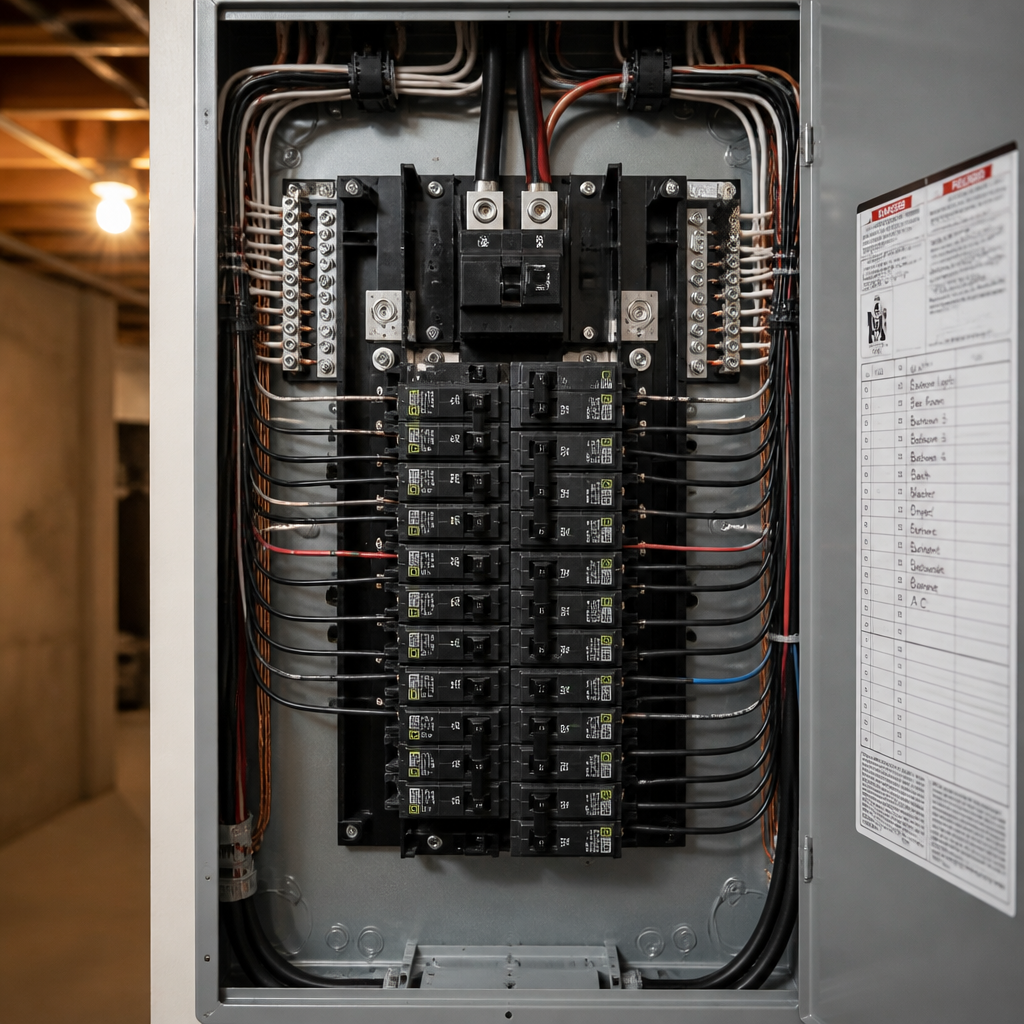
A panel upgrade replaces the home's existing service equipment with a new breaker box rated for 200 amps. This is not simply swapping one box for another. The scope of work typically includes the new panel enclosure, the main breaker, an updated meter socket, service entrance conductors, grounding rods, and bonding. In older homes, additional remediation may be required to bring grounding and wiring up to current code before the utility will reconnect service.
Panel Replacement vs. Full Service Upgrade
These two terms describe different scopes of work, and the distinction matters for budgeting. A panel replacement swaps the breaker box while the service entrance wiring and meter base remain intact, applicable when the existing service conductors are already rated appropriately. A full service upgrade replaces everything from the utility connection point through to the new panel, including the meter socket on the exterior of the home. Homes still on 60-amp or aluminum wiring-era service almost always require the full scope.
Code Compliance Requirements
Modern panels must meet current National Electrical Code standards, which include Arc-Fault Circuit Interrupter protection on specified circuits, Ground-Fault Circuit Interrupter protection in wet areas, and proper grounding and bonding throughout. A whole-house surge protector is increasingly standard on new installations. These are not optional add-ons. They are conditions of the final inspection that must pass before the utility restores power.
Pro tip: Request a load calculation from your electrician before any panel work begins. This document quantifies your home's existing demand, identifies available capacity, and formally justifies the upgrade to the permitting authority. It also serves as the baseline for sizing solar and battery storage correctly.
How a 200-Amp Panel Supports Solar System Connection
Solar inverters feed power back into the electrical panel to supply the home and, in grid-tied systems, to push surplus energy onto the utility grid. The National Electrical Code's 120% Rule governs this process. In plain terms, the rule states that the combined rating of the main breaker and the solar interconnection breaker cannot exceed 120% of the panel's busbar rating.
On a 100-amp panel with a 100-amp main breaker, the maximum allowable solar backfeed breaker is 20 amps, which supports only a modest solar array. On a 200-amp panel, the same calculation permits a 40-amp solar interconnection breaker, accommodating a meaningfully larger system. For most residential solar installations of 6 kilowatts or more, a 200-amp panel is a practical requirement rather than a recommendation.
An electrical panel upgrade to 200 amps replaces a home's existing service equipment with a higher-capacity system to safely manage the increased electrical load and bidirectional energy flow required by modern solar power systems.
Utility Interconnection and the Panel
When a solar system is installed in Delaware, Maryland, Pennsylvania, Virginia, New Jersey, or D.C., the local utility reviews the interconnection application and inspects the service equipment before granting permission to operate. Utilities in the Mid-Atlantic region consistently flag undersized panels as a barrier to interconnection approval. Addressing the panel upgrade before submitting the interconnection application removes this obstacle and avoids project delays that can stretch from weeks into months.
Pro tip: If your solar installer does not raise the subject of your panel rating during the initial site assessment, raise it yourself. The panel is the first point of contact between your solar system and your home's wiring. Discovering it is undersized after permits are filed adds time and cost that could have been avoided.
Electrical Panel Requirements for EV Charger Installation
A Level 1 charger uses a standard 120V outlet and draws approximately 12 amps. It adds roughly 3 to 5 miles of range per hour of charging, which satisfies low-mileage drivers but leaves most electric vehicle owners waiting overnight or longer for a full charge. A Level 2 EV charger operates at 240 volts and typically draws between 32 and 50 amps on a dedicated circuit, adding 15 to 30 miles of range per hour depending on the vehicle and charger output rating.
That dedicated 240V circuit must be sourced from available breaker slots in the panel. On a 100-amp service already serving a full household, available capacity is often insufficient. Adding a 50-amp EV charger circuit to an overloaded 100-amp panel is a code violation and a safety hazard. The electrical panel upgrade for EV charger installations is not advisory. It is a prerequisite in most cases.
Planning for Multiple Vehicles
Households with two electric vehicles need to account for two Level 2 circuits, which can represent 80 to 100 amps of dedicated load. Even on a 200-amp service, this requires careful load calculation to confirm that the panel can sustain this demand alongside baseline household consumption. Some installers recommend a load-sharing device that allows two chargers to share a single circuit and automatically balance amperage draw, reducing the panel demand without sacrificing charging speed significantly.
Battery Storage, Heat Pumps, and Other Growing Loads
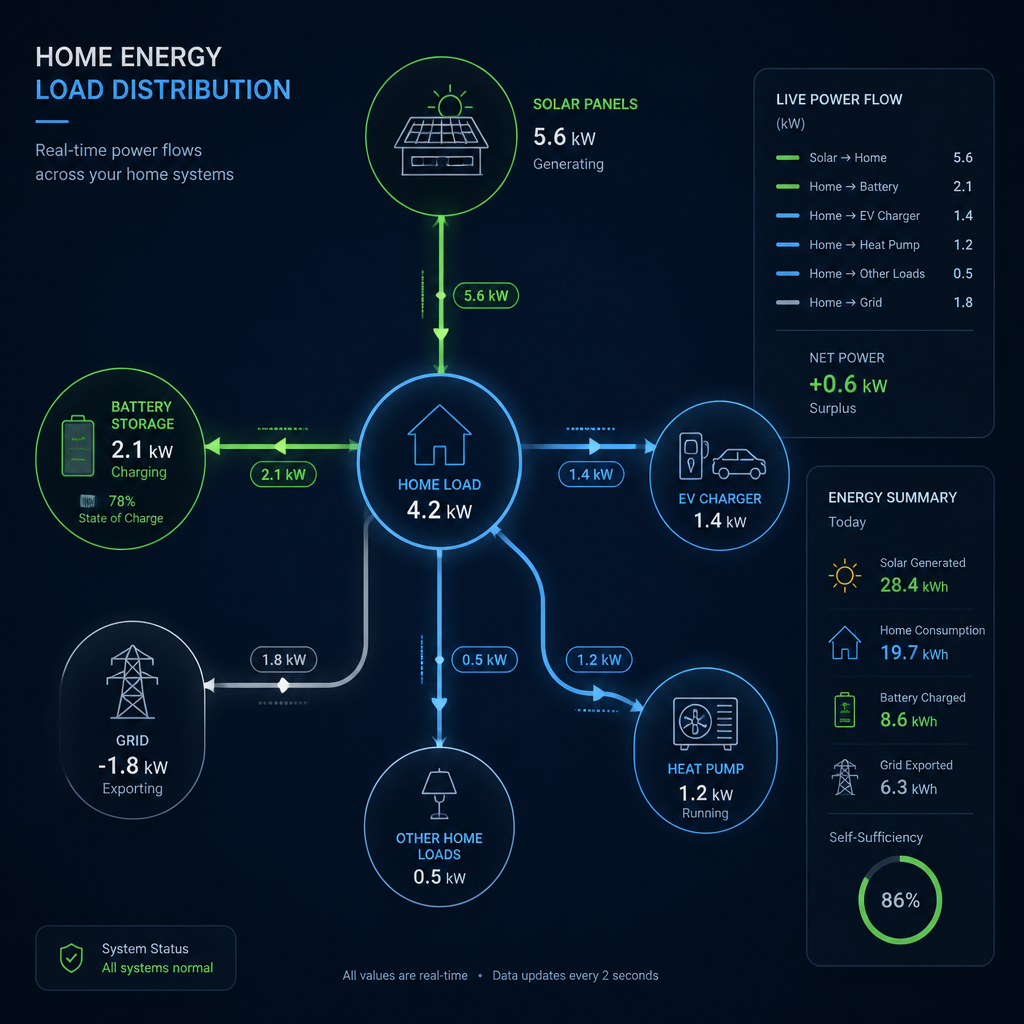
Battery storage systems such as whole-home backup units connect to the electrical panel through a dedicated transfer or interconnection circuit. Depending on the battery system's inverter output, this circuit may require 30 to 60 amps or more. Adding battery storage to a home that is already running solar and an EV charger from a 100-amp panel is not feasible without a service upgrade.
Heat pump water heaters and ducted heat pump HVAC systems represent another category of load growth that is accelerating across the Mid-Atlantic region. These systems are more efficient than resistance electric appliances, but they still require dedicated circuits. A 200-amp panel provides the circuit slots and total capacity to accommodate these additions without forcing a homeowner to choose between electrification upgrades.
The practical implication is this: a homeowner who upgrades to a 200-amp panel at the time of their first solar installation is positioned to add battery storage, an EV charger, and electrified HVAC over the following years without another service upgrade. A homeowner who defers the panel upgrade pays for that decision twice, once in a repeat service call and once in the disruption of another utility disconnect.
Comparing Panel Upgrade Scenarios: Which Applies to Your Home
Home Scenario | Typical Panel Situation | Recommended Action |
|---|---|---|
Pre-1990 home, adding solar only | 60 or 100-amp service, limited busbar capacity, may not satisfy NEC 120% Rule for planned solar array size | Full 200-amp service upgrade before or concurrent with solar installation |
Post-1990 home with 100-amp service, adding solar and Level 2 EV charger | 100-amp panel with limited spare capacity, cannot safely support both solar backfeed and a 40-50 amp EV circuit | 200-amp panel upgrade required; coordinate solar and EV charger installation together to reduce mobilization cost |
Home already on 200-amp service, adding solar, EV charger, and battery storage | 200-amp panel with adequate busbar capacity; may need additional breaker slots or a subpanel depending on existing circuit count | Load calculation to confirm available capacity; subpanel addition if breaker slots are exhausted; panel replacement only if equipment is outdated or damaged |
What to Expect from the Panel Upgrade Process
A residential panel upgrade follows a defined sequence. The licensed electrician begins with a site evaluation and load calculation, then files for electrical permits with the local building authority. In the Mid-Atlantic states, permit timelines vary by jurisdiction, but most residential electrical permits are issued within a few business days to a few weeks. Utility coordination for the disconnect and reconnect of service runs in parallel and can be the longest part of the timeline depending on the utility's scheduling queue.
On installation day, power to the home is shut off at the utility meter. The existing panel is removed, and the new 200-amp panel is installed. Depending on the scope, the meter socket and service entrance conductors may also be replaced at this stage. The electrician then reconnects all existing branch circuits, installs required AFCI and GFCI breakers on applicable circuits, and completes the grounding and bonding work. A local building inspector signs off on the completed installation before the utility restores power.
For homeowners in Delaware, Maryland, New Jersey, Pennsylvania, Virginia, and D.C. working with Triple R Energy on a panel upgrade, the process includes coordination with the applicable state utility, handling of all permits, and alignment with the solar or EV charger installation timeline so that all work is completed in a single coordinated sequence rather than staged visits. This approach reduces the number of utility disconnect events and keeps the project on a predictable schedule.
Pro tip: Confirm with your electrician that the new panel has a sufficient number of breaker slots for your planned additions, not just for what is being installed today. A 40-slot or 42-slot panel costs minimally more than a 24-slot unit at installation time, but eliminates the need for a subpanel if solar, battery storage, and EV charger circuits are added over subsequent years.
Frequently Asked Questions
Do I need a 200-amp panel upgrade to install solar panels?
Not in every case, but in most residential installations the answer is yes. Homes on 100-amp service frequently cannot satisfy the National Electrical Code's 120% Rule for solar backfeed without a panel upgrade, particularly for systems of 6 kilowatts or larger. A licensed electrician or solar system designer will perform a load calculation and busbar analysis during the design phase to determine whether an upgrade is required for a specific home and system size.
What is the NEC 120% Rule and why does it matter for solar?
The 120% Rule is a National Electrical Code provision that limits the total amperage allowed to feed into a panel's busbar. Specifically, the sum of the main breaker rating and the solar interconnection breaker rating cannot exceed 120% of the busbar's rated ampacity. On a 200-amp panel with a 200-amp busbar, this permits a solar interconnection breaker of up to 40 amps. On a 100-amp panel, the permitted solar breaker drops to 20 amps, which restricts the size of the solar array that can be connected in a standard line-side or load-side configuration.
How much does a 200-amp panel upgrade cost in the Mid-Atlantic region?
Industry data places the range for a 200-amp panel upgrade at roughly $1,300 to $7,350, with the wide variation reflecting differences in project scope. A straightforward panel swap where the service entrance wiring is already adequate sits at the lower end of that range. A full service upgrade that includes a new meter socket, service entrance conductors, grounding rods, and updated bonding sits at the higher end. Local permitting fees, utility reconnection charges, and the labor rates applicable to each Mid-Atlantic jurisdiction also affect the final number. Triple R Energy provides itemized estimates based on a site evaluation before any work is committed.
Can I install a Level 2 EV charger without upgrading my panel?
In some cases, if a home is already on 200-amp service with sufficient spare capacity, a Level 2 EV charger circuit can be added without a full panel upgrade. However, if the home is on 100-amp service or if the existing panel is fully loaded, a panel upgrade is a prerequisite for safe EV charger installation. Running a 40 to 50-amp EV charger circuit on an already-loaded 100-amp panel exceeds safe operating parameters and will not pass electrical inspection.
How long does a 200-amp panel upgrade take from permit to completion?
The physical installation typically takes one full day. The surrounding process, including permit filing, utility coordination for disconnect and reconnect, and final inspection scheduling, generally adds one to four weeks depending on the jurisdiction and the utility's scheduling availability. When the panel upgrade is coordinated with a concurrent solar or EV charger installation, the timelines are aligned so that the utility disconnect happens only once, reducing total project duration.
What is the difference between a panel upgrade and a subpanel installation?
A panel upgrade replaces the main service equipment with a higher-capacity unit. A subpanel installation adds a secondary distribution panel fed from the main panel, typically to serve a garage, workshop, or area of the home where additional circuits are needed. A subpanel does not increase the home's total service ampacity. If the main panel is undersized, adding a subpanel does not resolve the underlying capacity limitation. A subpanel is appropriate when the main panel has adequate ampacity but has exhausted its breaker slots.
Does Triple R Energy handle the permit and utility coordination for panel upgrades?
Yes. As a licensed electrical contractor serving Delaware, Maryland, New Jersey, Pennsylvania, Virginia, and Washington, D.C., Triple R Energy manages permit applications with the applicable local building authority and coordinates directly with the utility for the required service disconnect and reconnect. This is included in the project scope and is not left to the homeowner to arrange independently.
If you have recently completed a panel upgrade or are weighing one alongside a solar or EV charger project, sharing your experience, including what you wish you had known before the work began, helps other homeowners in the Mid-Atlantic region make better-informed decisions.