Maryland homeowners evaluating solar panels, battery storage, or electrical upgrades in 2026 are navigating a meaningfully different incentive landscape than existed even twelve months ago. The 30% federal residential clean energy credit that once anchored most cost projections has expired for homeowner-purchased systems placed in service after December 31, 2025. At the same time, the state has launched a new battery storage grant program and continues to operate one of the strongest net metering policies in the mid-Atlantic region. Understanding which Maryland solar incentives 2026 are active, which have closed, and how they interact with the real cost of solar service and battery installation is essential before committing to any project.
Table of Contents
- Maryland Solar Incentive Overview for 2026
- The Federal Solar Tax Credit: What Changed for 2026
- The RCES Battery Storage Grant Program
- The Maryland Solar Access Program (MSAP)
- SRECs and Net Metering in Maryland
- Property Tax and Sales Tax Exemptions
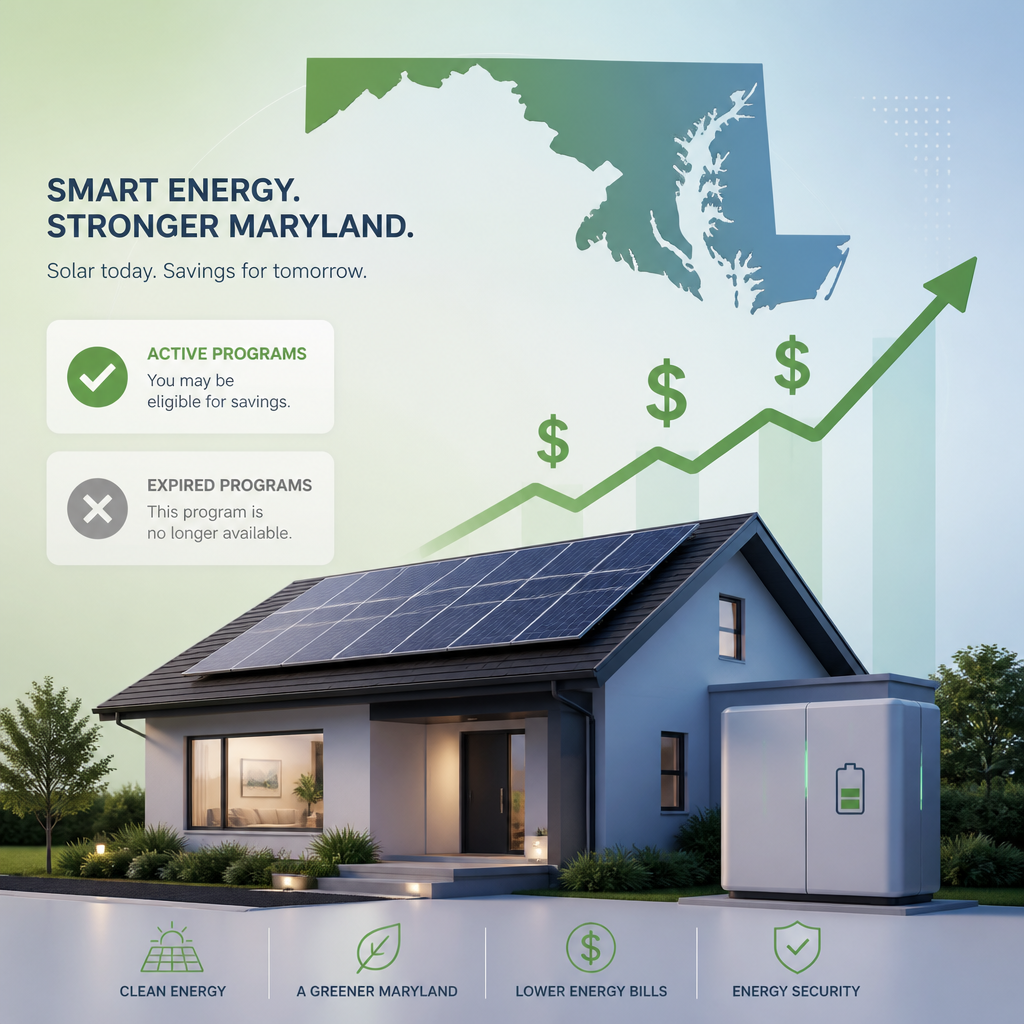
- Incentive Comparison: Active vs. Closed Programs
- How Incentives Affect Solar Service and Battery Storage Costs
- Frequently Asked Questions
- References
Maryland Solar Incentive Overview for 2026
The 2026 incentive stack in Maryland is a combination of active state programs, permanent tax exemptions, and ongoing utility billing policies. It no longer includes the 30% homeowner-claimed federal tax credit that drove many prior-year financial models. Homeowners who are starting to evaluate projects now need to build their savings projections around what is actually available, not what was available in 2024 or early 2025.
Maryland's core active programs as of mid-2026 include the Residential and Commercial Energy Storage (RCES) grant, the Maryland Solar Access Program (MSAP) for income-eligible households, statewide sales and property tax exemptions, solar renewable energy certificates (SRECs), and full retail-rate net metering. Each of these programs has distinct eligibility requirements, funding caps, and timelines that directly affect the net cost of a residential installation.
For homeowners in Delaware, Maryland, New Jersey, Pennsylvania, Virginia, and Washington, D.C., working with a licensed electrical contractor who understands current program rules is not optional. Incentive deadlines move quickly, and applications submitted with missing documentation can be placed on standby or rejected outright, which means lost grant money that cannot be recovered after the fact.
Key Insight | Explanation |
|---|---|
Federal 30% residential ITC expired for purchased systems | The Section 25D credit ended for homeowner-owned systems placed in service after December 31, 2025. Leased or PPA-financed systems may still benefit through the third-party owner's credit. |
New RCES battery storage grant replaces old tax credit | Maryland's Residential and Commercial Energy Storage (RCES) Program launched for FY2026, offering grants of up to 30% of battery installation costs (capped at $5,000) on a first-come, first-served basis with a $2,000,000 total budget. |
RCES funds fill quickly | The FY2026 RCES grant accepts applications through 3:00 PM ET on June 5, 2026, or until funds are exhausted. Applications with documentation errors go to standby status, not the queue. |
Maryland's net metering policy is unusually strong | Credits for excess solar generation roll over indefinitely and are applied at the full retail rate, making system sizing decisions more financially forgiving than in states that have cut net metering value. |
Solar equipment is exempt from Maryland's 6% sales tax | The exemption applies to equipment that generates electricity or hot water, reducing the upfront cost of both solar panels and eligible battery storage hardware. |
Property tax exemption protects home value calculations | Solar installations do not increase Maryland real property tax assessments statewide, meaning the added home value from solar does not translate into a higher annual tax bill. |
MSAP grants target income-eligible households | The Maryland Solar Access Program offers solar PV grants to households at or below 150% of area median income, with an FY2026 budget of $12,000,000 on a first-come, first-served basis. |
The Federal Solar Tax Credit: What Changed for 2026
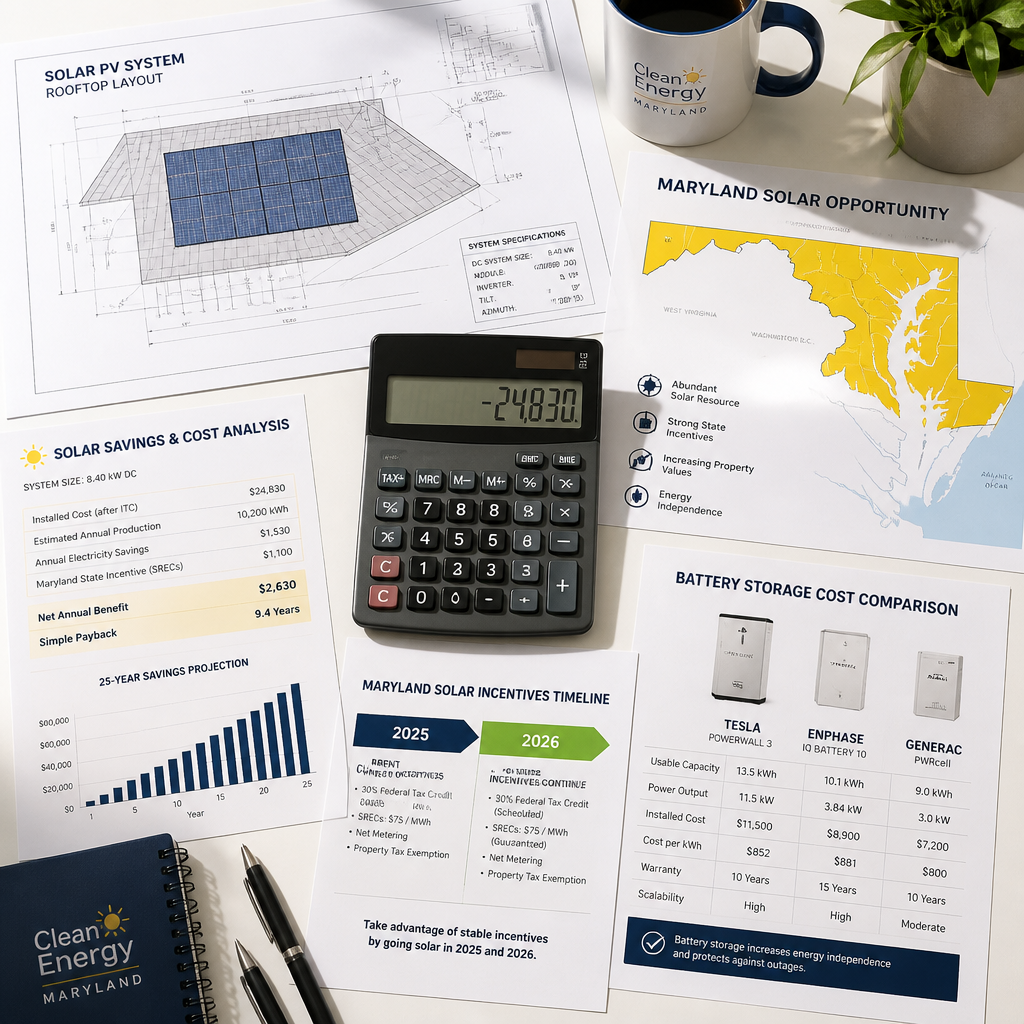
Through the end of 2025, the Section 25D Residential Clean Energy Credit allowed homeowners who purchased a solar system outright or with a loan to claim a federal income tax credit equal to 30% of eligible project costs. For a typical Maryland system, that credit was worth roughly $6,900 against a homeowner's federal tax liability. That credit is no longer available for homeowner-owned systems placed in service in 2026 or later.
What the Expiration Means in Practice
Homeowners who completed and placed their solar systems in service by December 31, 2025 can still claim the 30% credit on their 2025 federal tax return. Unused credit amounts from prior qualifying years can still carry forward. However, systems installed from January 1, 2026 onward do not qualify for the Section 25D credit if the homeowner is the system owner.
Third-party-owned systems, meaning those financed through a solar lease or power purchase agreement (PPA), operate under a different credit mechanism. The financing company claims the business investment tax credit (Section 48E) and may pass a portion of that benefit through in the form of lower rates. Homeowners choosing the lease or PPA route do not claim a credit themselves but may see cost advantages reflected in their contract pricing. The distinction between ownership structures now has a direct and significant impact on net project economics.
The loss of the Section 25D credit shifts the center of gravity for Maryland solar economics firmly toward the state's own programs and its permanently favorable tax and billing policies. Homeowners who act on available state incentives before funding closes will see meaningfully better outcomes than those who wait.
Pro tip: Before signing any solar contract in 2026, confirm in writing whether the installer is positioning the project as homeowner-purchased or third-party-owned, and ask specifically how the absence of the Section 25D credit is reflected in the project's savings projection. Many pro forma estimates circulating in the market were built on the prior 30% credit and have not been updated.
The RCES Battery Storage Grant Program
The Residential and Commercial Energy Storage (RCES) Program is Maryland's primary state-level incentive for battery storage systems in 2026. Administered by the Maryland Energy Administration (MEA), the program was established under Section 9-2012 of the State Government Article of the Annotated Code of Maryland and formally replaces the Maryland Energy Storage Income Tax Credit Program, which ended at the close of calendar year 2024.
Grant Amount and Eligible Costs
The RCES grant covers 30% of the installed cost of a grid-connected battery energy storage system (BESS), up to a maximum of $5,000 per residential applicant. The FY2026 program carries a total budget of $2,000,000, funded through Maryland's Strategic Energy Investment Fund (SEIF). Grants are awarded on a non-competitive, first-come, first-served basis using a two-step application process managed through the MEA.
Applications are accepted through 3:00 PM ET on June 5, 2026, or until all allocated funds are fully distributed, whichever occurs first. Applications submitted with missing or incorrect documentation are placed on standby status. The applicant is then notified and must submit corrections within 14 calendar days, or the application may be rejected. This procedural requirement is not a minor administrative detail: a documentation error effectively removes an applicant from the active queue while funds continue to be awarded to properly completed submissions.
How RCES Stacks With Other Incentives
The RCES grant can be applied to a standalone battery installation or to a battery added alongside a solar PV system. Because battery hardware is also exempt from Maryland's 6% sales tax, homeowners receive two separate reductions on the installed cost before any utility billing benefits are considered. For a $10,000 battery installation, the RCES grant alone reduces the cost to approximately $7,000, with the sales tax exemption providing additional savings on equipment purchased for the project.
Pro tip: Contact the MEA's Energy Storage Team at EnergyStorage.MEA@Maryland.gov before submitting an RCES application to confirm current fund availability and documentation requirements. The program's first-come, first-served structure means there is no benefit to delaying a submission while funds remain open, and no recourse if funds close before a corrected application is resubmitted.
The Maryland Solar Access Program (MSAP)
The Maryland Solar Access Program (MSAP) is a solar PV installation grant targeted specifically at income-eligible Maryland residents. Eligibility is limited to households whose annual income does not exceed 150% of the area median income for their county. The FY2026 round of MSAP carried a budget of $12,000,000 and operated on a first-come, first-served basis, with individual grant amounts determined by MEA's Maximum Offer Calculator based on system size and location.
Systems funded through MSAP must be installed by contractors approved by the Maryland Energy Administration. This requirement is consequential: a homeowner who selects an installer that is not on MEA's approved list before submitting an MSAP application will not be able to use that grant for the project. Verifying contractor approval status before signing any installation agreement is an essential early step for income-eligible applicants.
The FY2026 MSAP round closed to new applications mid-cycle as available funds were committed. Homeowners interested in the MSAP for a future fiscal year should monitor MEA's website for FY2027 program announcements, as the program has been renewed in successive years and is likely to continue.
SRECs and Net Metering in Maryland
Solar Renewable Energy Certificates (SRECs) are certificates issued for each megawatt-hour of electricity a solar system generates. Maryland utilities are required under the state's Renewable Portfolio Standard to source a growing share of their electricity from solar, and they purchase SRECs from solar owners to meet that obligation. Each SREC represents a tangible revenue stream separate from the electricity savings a system produces.
SREC Market Conditions
SREC values in Maryland have generally declined over the past several years as solar capacity has grown statewide. However, Maryland's Renewable Portfolio Standard requires utilities to source 50% of electricity from renewables by 2030, with 14.5% specifically from solar by 2028. That policy commitment sustains ongoing demand for SRECs and provides a structural floor for SREC market pricing. Homeowners should treat SREC income as a secondary benefit rather than the primary basis for a financial projection, given that market values shift over time.
Net Metering: Maryland's Most Durable Incentive
Net metering is the billing arrangement under which a solar system owner receives full retail-rate credits for excess electricity sent to the grid. Maryland's net metering policy is notably favorable: credits roll over indefinitely, meaning excess production from high-sun months can offset utility charges in low-production months without expiration. This indefinite rollover distinguishes Maryland from a number of states that have moved to monthly credit expiration or reduced the rate at which excess generation is credited.
The practical effect of indefinite credit rollover is that a system slightly oversized relative to current consumption can accumulate credits that offset winter electricity costs, rather than leaving value stranded. For homeowners adding battery storage to a solar system, net metering and storage together provide both grid independence during outages and continuous billing optimization throughout the year.
Property Tax and Sales Tax Exemptions
Maryland provides two permanent tax exemptions that apply to qualifying residential solar installations regardless of system size, household income, or the availability of other program funding. These exemptions do not carry application deadlines or budget caps and are available to any eligible solar installation statewide.
The sales tax exemption waives Maryland's 6% state sales and use tax on qualifying solar energy equipment, including panels, inverters, and battery storage systems that generate or store electricity. The exemption reduces the effective upfront cost of a system compared with states that tax solar equipment at standard retail rates.
The property tax exemption ensures that the assessed value of a Maryland home is not increased as a result of a solar installation. Solar panels and associated equipment add measurable market value to a property, but that added value is excluded from the real property tax assessment statewide. In addition, certain Maryland counties including Anne Arundel, Baltimore, Harford, and Prince George's counties offer one-time local property tax credits. Homeowners in those jurisdictions should contact their local tax authority to confirm current program availability and application requirements.
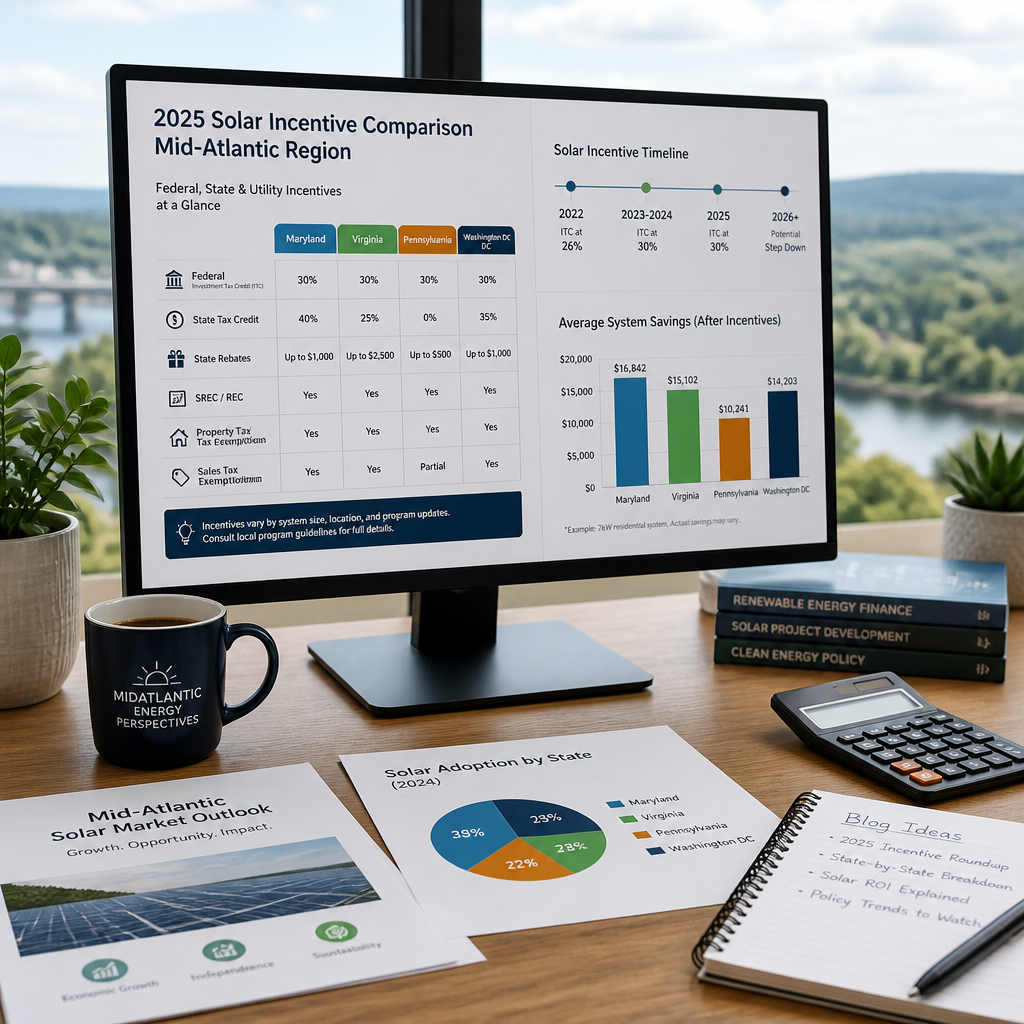
Incentive Comparison: Active vs. Closed Programs
Program | Status in 2026 | Benefit and Key Limit |
|---|---|---|
Federal Section 25D Residential Clean Energy Credit | Expired for homeowner-owned systems placed in service after Dec 31, 2025 | Was 30% of system cost, no cap. No longer available for purchased systems. Third-party-owned systems may still access related credits through Section 48E. |
Maryland RCES Battery Storage Grant | Active, FY2026 applications open through June 5, 2026 or until funds exhausted | 30% of battery installation cost, up to $5,000. $2,000,000 total FY2026 budget. First-come, first-served. Replaces the ended Energy Storage Income Tax Credit. |
Maryland Solar Access Program (MSAP) | FY2026 round closed mid-cycle; watch for FY2027 announcement | Solar PV installation grant for households at or below 150% of area median income. FY2026 budget was $12,000,000. Requires MEA-approved installer. |
Maryland Energy Storage Income Tax Credit | Closed, ended December 31, 2024 | Was a 30% state income tax credit up to $5,000. Fully replaced by RCES grant program for FY2026. |
Net Metering | Active, indefinite rollover at full retail rate | Credits for excess solar generation apply at the full retail electricity rate and roll over without expiration. One of the strongest net metering policies in the mid-Atlantic region. |
Maryland Sales Tax Exemption (Solar Equipment) | Active, permanent | Waives the 6% state sales and use tax on qualifying solar and battery equipment. No application required. |
Maryland Property Tax Exemption (Solar) | Active, permanent statewide | Added home value from solar excluded from real property tax assessment statewide. Certain counties offer additional one-time local credits. |
SRECs (Solar Renewable Energy Certificates) | Active, market prices vary | One SREC issued per MWh generated. Market values have declined over time but remain supported by Maryland's Renewable Portfolio Standard solar carve-out. |
How Incentives Affect Solar Service and Battery Storage Costs
The expiration of the federal Section 25D credit changes the math of a solar project significantly for homeowners who intend to own their systems outright. A 2025-era financial model that assumed $6,900 or more in federal tax credits is no longer valid for a 2026 installation. Homeowners reviewing quotes or proposals prepared before mid-2025 should request updated figures that reflect only the incentives that are currently available.
Modeling Costs Without the Federal ITC
For a homeowner in Maryland purchasing a solar system in 2026, the primary cost offsets are the 6% sales tax exemption, indefinite net metering credits, and ongoing SREC income. For battery storage added to that system, the RCES grant of up to $5,000 provides the most significant immediate reduction in installed cost. A homeowner who secures the RCES grant before funds close and who benefits from Maryland's sales tax exemption, permanent property tax protection, and net metering credits is still in a favorable position relative to most other states, even without the federal ITC.
In practice, the most common error made by homeowners evaluating 2026 solar projects is comparing savings projections from multiple installers without confirming whether each proposal reflects current incentive status. A proposal that includes a line item for the federal 30% homeowner credit on a purchased system placed in service in 2026 contains a material inaccuracy. Catching that error before signing a contract prevents downstream financial surprises.
Battery Storage and Electrical Upgrades
Battery storage installations frequently require an electrical panel upgrade or service upgrade to support the additional load and interconnection requirements of a battery system. The cost of that panel work is a real component of the project budget and should be factored into any incentive analysis. In Maryland, the RCES grant covers the battery storage system installation cost, but does not cover ancillary electrical work that is not directly part of the storage system itself. Separating those line items clearly in a project proposal allows homeowners to understand which costs qualify for available incentives and which do not.
EV charger installations, which are increasingly requested alongside solar and storage projects, are not covered by Maryland's current solar or battery incentive programs. Federal credits for EV charger installation under Section 30C may apply to qualifying equipment and installations, though the availability of that credit in 2026 depends on the specific circumstances of the installation and the applicable tax year. Homeowners considering combined solar, storage, and EV charger projects should review current federal guidance or consult a tax professional for the charger component specifically.
Pro tip: When requesting project proposals for battery storage in Maryland, ask each installer to itemize the RCES-eligible battery system costs separately from panel upgrades, wiring, and other electrical work. This makes it straightforward to verify the grant calculation and ensures the application to MEA reflects the correct eligible cost basis.
Frequently Asked Questions
Is the 30% federal solar tax credit still available in Maryland in 2026?
The 30% Section 25D Residential Clean Energy Credit expired for homeowner-purchased and homeowner-owned systems placed in service after December 31, 2025. Homeowners who completed qualifying installations by that date can still claim the credit on their 2025 federal tax return. For systems placed in service in 2026 or later under homeowner ownership, the credit is no longer available. Third-party-owned systems financed through a lease or PPA may still be associated with a credit claimed by the financing entity under separate business credit provisions.
What is the MD solar tax credit situation for battery storage in 2026?
Maryland's state-level Energy Storage Income Tax Credit ended on December 31, 2024. It has been replaced for FY2026 by the Residential and Commercial Energy Storage (RCES) grant program administered by the Maryland Energy Administration. The RCES program offers a grant of 30% of eligible battery installation costs, up to $5,000, with a total FY2026 budget of $2,000,000. Applications are accepted on a first-come, first-served basis through June 5, 2026, or until funds are fully committed.
What is the battery storage incentive in Maryland and how do I apply?
The battery storage incentive in Maryland for FY2026 is the RCES grant program. To apply, homeowners submit a two-step application to the Maryland Energy Administration. Applications with missing or incorrect documentation are placed on standby rather than the active queue, and applicants have 14 calendar days to correct errors before the application may be rejected. For program questions and current fund availability, MEA's Energy Storage Team can be reached at EnergyStorage.MEA@Maryland.gov.
Does installing solar panels increase my property taxes in Maryland?
No. Maryland provides a statewide property tax exemption for solar installations. The added value that solar panels contribute to a home's market value is excluded from the real property tax assessment, meaning a solar installation does not result in a higher annual property tax bill. Certain Maryland counties, including Anne Arundel, Baltimore, Harford, and Prince George's counties, have offered additional one-time local property tax credits. Homeowners in those areas should contact their local tax authority to confirm what is currently available.
How does Maryland net metering work and is it still available in 2026?
Maryland's net metering policy remains active in 2026. Under net metering, solar system owners receive a credit on their utility bill for each kilowatt-hour of excess electricity sent to the grid, valued at the full retail electricity rate. Credits roll over indefinitely from month to month, allowing excess production in high-sun months to offset consumption in winter months. This indefinite rollover at full retail value distinguishes Maryland's net metering from policies in states that cap credit periods or compensate excess generation at a reduced wholesale rate.
Can I combine multiple Maryland solar incentives on the same project?
Yes, multiple incentives can generally apply to the same project. A Maryland homeowner installing a solar system paired with battery storage in 2026 can benefit simultaneously from the RCES battery grant (up to $5,000), the statewide sales tax exemption on qualifying equipment, the statewide property tax exemption, net metering credits for excess solar generation, and ongoing SREC income. The RCES grant specifically covers the battery storage installation cost, while the tax exemptions apply broadly to qualifying solar and battery equipment regardless of other program participation.
Does a solar installation in Maryland require a licensed electrical contractor?
Solar PV and battery storage installations involve electrical work that must be performed by appropriately licensed contractors. In Maryland and across the mid-Atlantic states, proper licensing protects the homeowner's eligibility for utility interconnection, building permits, and program incentives. For MSAP-funded projects, MEA additionally requires that the installer be approved by the Maryland Energy Administration before the application is submitted. Working with a licensed electrical contractor who is familiar with both state program requirements and local permitting is the most reliable way to ensure a project qualifies for all available incentives without procedural complications.
If you have recently completed a solar, battery storage, or electrical upgrade project in Maryland, sharing your experience with current incentive programs helps other homeowners in the mid-Atlantic region make better-informed decisions.
References
Maryland Energy Administration: Official RCES Energy Storage Grant Program page
Solar Incentives by State: Maryland active and closed program summary for 2026
EnergySage: Explanation of the federal residential solar tax credit expiration for 2026
Solar Energy World: Analysis of Maryland solar economics and policy outlook for 2026