Most homeowners who purchase an electric vehicle underestimate how significantly the charging setup affects daily driving. A standard wall outlet provides roughly 4 to 5 miles of range per hour of charging, which is rarely adequate for regular use. The solution is a Level 2 home charger, and the foundation of any safe, code-compliant Level 2 installation is a dedicated circuit for the EV charger. Understanding what that circuit is, how it must be sized, and what it demands of your existing electrical system is essential before scheduling any installation work in Delaware, Maryland, New Jersey, Pennsylvania, Virginia, or Washington, D.C.
Table of Contents
- Quick Takeaways
- What Is a Dedicated Circuit?
- Why EV Chargers Require a Dedicated Circuit
- Understanding the 50A Circuit for EV Charging
- NEC Article 625: The Code Behind the Requirement
- What Your Electrical Panel Must Support
- Comparison of EV Charging Circuit Configurations
- The Installation Process: What to Expect
- Frequently Asked Questions
- References
Quick Takeaways
Key Insight | Explanation |
|---|---|
A dedicated circuit serves only one load | No other outlets, lights, or appliances share the circuit with the EV charger, preventing overload and interference. |
Level 2 chargers require 240V | A 240-volt, double-pole breaker is required for any Level 2 charger installation; standard 120V outlets cannot support this load reliably. |
The NEC mandates 125% sizing | Because EV charging is a continuous load, NEC Article 625 requires the circuit breaker and wiring to be rated at 125% of the charger's maximum output. |
A 40A charger needs a 50A circuit | The most common residential Level 2 charger draws 32A continuously, requiring a 40A breaker minimum. A 40A charger output requires a 50A dedicated circuit. |
Wire gauge must match amperage and run length | A 50A circuit typically requires 6 AWG copper conductor. Longer runs to a detached garage may require 4 AWG to stay within safe voltage drop limits. |
Panel capacity must be evaluated first | A 100-amp service panel may not have adequate headroom for a new 50A or 60A double-pole breaker, making a panel upgrade necessary before installation. |
Permits and inspections are non-negotiable | In Delaware, Maryland, New Jersey, Pennsylvania, Virginia, and D.C., a new EV charger circuit is notifiable electrical work requiring a permit and final inspection. |
What Is a Dedicated Circuit?
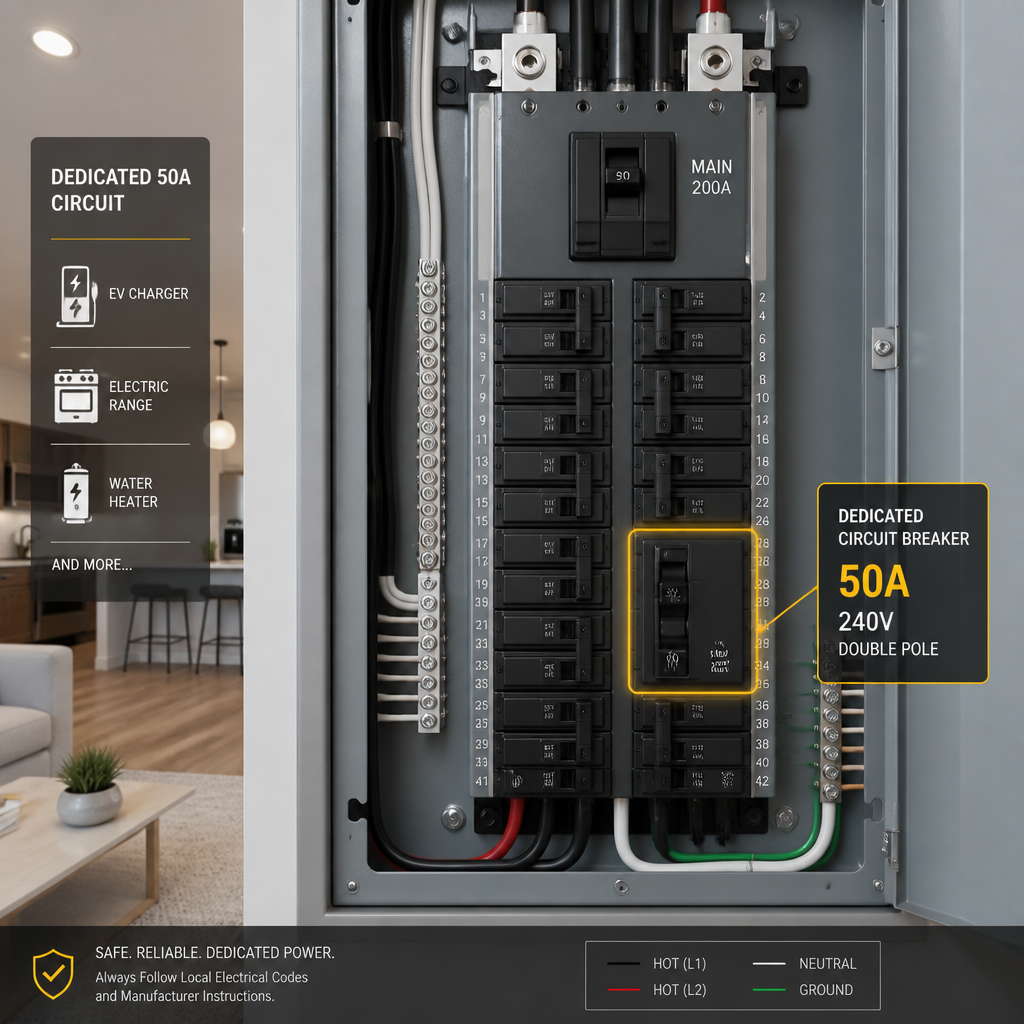
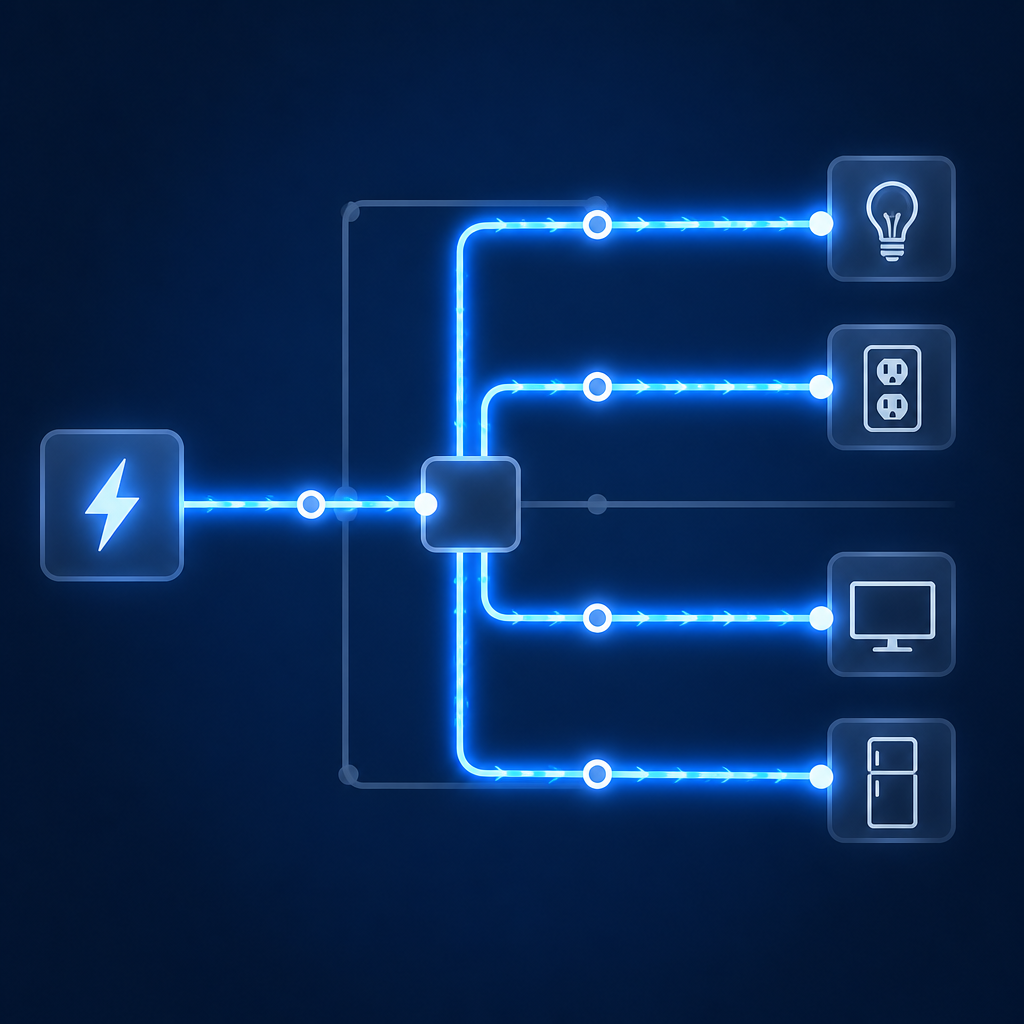
A dedicated circuit is a branch circuit in a home's electrical system that originates at the panel with its own breaker and runs directly to a single appliance or piece of equipment, with no other devices connected to it. No outlets, no lights, no other loads share that breaker or that wiring path.
This configuration is already required for several high-draw household appliances: electric dryers, electric ranges, central air conditioning units, and dishwashers are common examples. These devices draw substantial, sustained current that would overload a shared circuit and risk tripping breakers or overheating conductors. An EV charger dedicated circuit belongs in exactly this category.
In practice, a dedicated circuit consists of three components: a correctly sized double-pole circuit breaker installed in the main panel, an appropriately gauged conductor run from the panel to the charger location, and a termination point that is either a receptacle outlet or a hardwired connection directly to the charger unit. Each element must be matched to the charger's electrical specifications and compliant with local code requirements.
Why EV Chargers Require a Dedicated Circuit
EV charging is classified as a continuous load under the National Electrical Code. A continuous load is any electrical load expected to operate for three hours or more without interruption. Charging an electric vehicle overnight easily satisfies this definition. Continuous loads generate sustained heat in conductors and breakers, and the NEC addresses this by requiring circuits and components to be sized at 125% of the maximum continuous draw.
Sharing a circuit with other appliances creates compounding risk. The combined load from a charger and, for example, a refrigerator or lighting circuit can push total current draw above the breaker's rating, causing frequent tripping. More seriously, sustained current at or above a conductor's rated ampacity causes the wiring insulation to degrade over time, creating a fire hazard that is not always immediately visible. Shared circuits also introduce voltage instability, which can result in inconsistent charging speeds and, in some cases, stress on the vehicle's onboard charging hardware.
The dedicated circuit requirement is not simply good practice. It is a legal requirement enforced through code inspections across every jurisdiction Triple R Energy serves.
EV charging equipment draws a sustained, high-current load that no shared residential circuit is designed to handle safely over thousands of charging cycles. The dedicated circuit requirement exists precisely because the consequences of getting it wrong accumulate gradually, until they do not.
Risks of an Improperly Wired EV Charger
Connecting a Level 2 charger to a shared or undersized circuit produces several failure modes. Nuisance tripping is the most immediately obvious: the breaker interrupts charging mid-session, disrupting overnight charge completion. Wiring overheating is more serious and less visible, as undersized conductors running at sustained elevated current can reach temperatures that degrade insulation without immediately tripping the breaker. In the worst cases, degraded insulation inside a wall or ceiling cavity can ignite surrounding material.
Using an electric dryer outlet as a shortcut is a frequently attempted workaround that should be avoided. Dryer circuits are not rated for continuous high-current draw, and the NEMA 14-30 receptacle commonly used for dryers is rated at only 30 amperes, which is below the minimum recommended for most Level 2 chargers.
Pro tip: If a prior owner or installer connected an EV charger to an existing outlet without a dedicated circuit, schedule a panel inspection before using it further. Sustained overloading may have already caused conductor damage that is not immediately apparent.
Understanding the 50A Circuit for EV Charging
The 50A circuit for EV charging is the most commonly installed residential configuration in the Mid-Atlantic region, and it supports the majority of Level 2 home chargers available. Understanding how that rating is derived helps homeowners make informed decisions about which charger to purchase and what their installation will require.
How the 125% Rule Determines Circuit Size
A charger rated at 40 amperes of continuous output requires a circuit breaker rated at 40 × 1.25, or 50 amperes. This is the NEC's continuous load rule applied directly. The 50A double-pole breaker serves a charger that delivers 40A to the vehicle, and the wiring between the panel and the charger must be sized for the full 50A circuit rating, not the charger's output rating. For a 50A circuit, 6 AWG copper conductor is the standard minimum for runs up to approximately 50 feet. Longer runs, particularly to detached garages or exterior installations, may require 4 AWG copper to keep voltage drop within acceptable limits.
Receptacle vs. Hardwired Installations
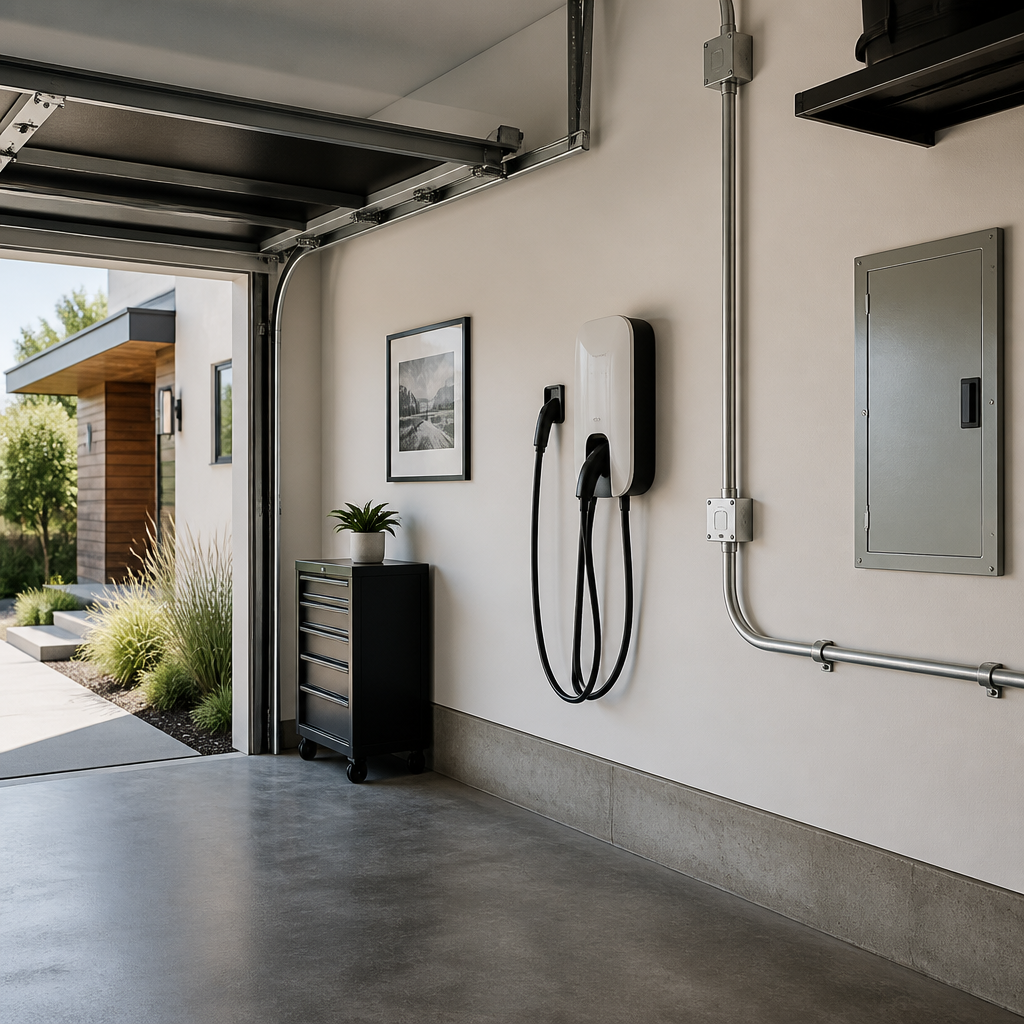
A 50A circuit can terminate in either a NEMA 14-50R receptacle or a hardwired connection directly to the charger unit. Receptacle installations allow the charger to be unplugged and moved, which some homeowners prefer for flexibility. Hardwired installations are required for chargers rated above 50 amperes and are often preferred for higher-amperage units because they eliminate the receptacle as a potential point of failure under sustained high-current operation. Both approaches are code-compliant when properly installed; the right choice depends on the specific charger model and the homeowner's long-term plans.
NEC Article 625: The Code Behind the Requirement
The National Electrical Code's Article 625 governs all Electric Vehicle Power Transfer Systems in the United States. It is the primary code authority for residential and commercial EV charger installations and is adopted, often with local amendments, across Delaware, Maryland, New Jersey, Pennsylvania, Virginia, and Washington, D.C.
Section 625.42 establishes the dedicated branch circuit requirement explicitly: each EVSE (Electric Vehicle Supply Equipment) must be supplied by a dedicated branch circuit. An exception exists for installations using an approved energy management system that actively controls load, but this is uncommon in standard residential contexts. Section 625.41 addresses continuous load sizing, requiring branch circuits to be rated at 125% of the charger's maximum current.
Section 625.54 requires GFCI (ground-fault circuit interrupter) protection for all EV charging equipment. Many modern Level 2 chargers incorporate GFCI protection internally, but where the unit does not, a GFCI breaker at the panel is required. Local authorities having jurisdiction (AHJ) in some Mid-Atlantic jurisdictions have adopted the 2023 NEC edition, while others remain on the 2020 or 2017 editions; the GFCI requirement has been present across all recent editions.
Pro tip: Before purchasing a Level 2 charger, confirm whether the unit is listed by a recognized testing laboratory such as UL or ETL. Code-compliant installation requires listed equipment. Unlisted chargers cannot be legally installed under permit in any jurisdiction Triple R Energy serves.
What Your Electrical Panel Must Support
Installing a dedicated circuit for an EV charger is straightforward when the main service panel has adequate capacity. The challenge arises when it does not. A 50A double-pole breaker occupies two slots in the main panel and adds a meaningful load to the total service capacity. Whether that addition is feasible depends on two factors: available breaker slots and remaining ampacity headroom.
Evaluating Panel Capacity Before Installation
A licensed electrician performs a load calculation to determine how much of the panel's rated capacity is already committed to existing circuits. For a 200A service panel, there is generally sufficient headroom to add a 50A or 60A EV charger circuit, provided the existing load is not unusually high. A 100A service panel is a different situation. Homes in the Mid-Atlantic region built before the 1980s commonly have 100A service, and these panels frequently lack the remaining headroom to safely accommodate a Level 2 charger circuit without a service upgrade.
The practical test is straightforward: open the main panel, locate the main breaker at the top, and note its amperage rating. Then compare the sum of all existing double-pole breaker ratings against that service limit. If the math leaves less than 50 to 60 amperes of unused capacity, a panel upgrade is likely necessary before the EV circuit can be added.
When a Panel Upgrade Is Required
A service upgrade, typically from 100A to 200A, involves replacing the main panel, updating the meter base, and coordinating with the local utility to upgrade the service entrance conductors. This work requires permits and utility coordination in every Mid-Atlantic jurisdiction. The process adds time and cost to the overall EV charger project, but it also delivers lasting benefits: a 200A panel supports future electrical loads including battery storage systems, additional EV chargers, and all-electric appliances. Triple R Energy handles electrical panel and service upgrades as part of a complete EV charger installation, so homeowners do not need to coordinate two separate contractors.
Some older panels also present a different concern: brand or model-specific compatibility. Certain panel brands have known issues with breaker reliability under sustained high-current operation. A licensed electrician familiar with the specific panel manufacturer can advise whether replacement is warranted independently of capacity concerns.
Comparison of EV Charging Circuit Configurations
Configuration | Typical Use Case | Key Considerations |
|---|---|---|
40A Dedicated Circuit (32A charger output) | Homeowners with shorter daily drives and a single EV; suitable when panel headroom is limited | Adds approximately 25 miles of range per hour; 8 AWG copper conductor; most cost-effective initial install |
50A Dedicated Circuit (40A charger output) | Most common residential Level 2 installation; supports the majority of current EV models | Adds approximately 30-35 miles of range per hour; 6 AWG copper conductor; NEMA 14-50R receptacle or hardwired; balances performance and cost |
60A Dedicated Circuit (48A charger output) | Homeowners with long daily commutes, large-battery EVs, or plans for a second vehicle | Adds approximately 40+ miles of range per hour; hardwired installation required above 50A; 6 AWG copper for shorter runs, 4 AWG for longer; requires higher panel headroom |
The Installation Process: What to Expect
A properly executed EV charger installation involving a dedicated circuit follows a defined sequence of steps. Understanding that sequence helps homeowners set accurate timelines and avoid the mistakes that arise from skipping steps.
Site Assessment and Load Calculation
The first step is a site assessment conducted by a licensed electrician. This includes inspecting the main panel, determining available capacity, measuring the intended circuit run from the panel to the charger location, and identifying any conduit, trenching, or structural considerations for the wire routing. The Triple R Energy EV charger installation process begins with exactly this evaluation, ensuring that equipment recommendations and cost estimates reflect the actual conditions of the home rather than generic assumptions.
Permitting and Utility Coordination
Adding a new 240V dedicated circuit is notifiable electrical work in every jurisdiction Triple R Energy serves. A licensed contractor pulls the required permit with the local authority having jurisdiction before any work begins. Skipping this step creates liability for the homeowner and may complicate homeowner's insurance claims in the event of an incident. If a service upgrade is part of the project, utility coordination for the meter base and service entrance work adds additional lead time, typically several days to a few weeks depending on the utility's scheduling.
Installation and Inspection
Once the permit is issued, the physical installation proceeds: the breaker is installed in the panel, the conductor is run through conduit or within the wall assembly to the charger location, and the receptacle or hardwired termination is completed. A final inspection by the local authority confirms code compliance before the circuit is energized. This inspection is the formal sign-off that the installation is safe, and it protects the homeowner from future liability. Triple R Energy coordinates the final inspection scheduling as part of every installation, so homeowners do not need to manage that process independently.
The complete timeline from site assessment to energized charger, assuming no panel upgrade is needed, is typically one to two days of work plus permit and inspection scheduling. Panel upgrade projects take longer due to utility coordination requirements.
Frequently Asked Questions
Can an EV charger share a circuit with my electric dryer?
No. The NEC requires EV charging equipment to be supplied by a dedicated branch circuit with no other loads connected. Beyond the code prohibition, a dryer circuit is typically rated at 30 amperes and uses a NEMA 14-30 receptacle, which is undersized for most Level 2 chargers. Using a dryer circuit for EV charging creates a code violation and a sustained overload risk.
What is the difference between a 40A and a 50A circuit for EV charging?
A 40A dedicated circuit supports a charger that delivers up to 32A of continuous output to the vehicle. A 50A circuit supports a charger that delivers up to 40A. The difference translates to approximately 5 to 10 additional miles of range added per hour of charging. For homeowners with longer daily commutes or larger-battery vehicles, the 50A configuration is generally the better investment over the life of the installation.
Do I need a panel upgrade to install an EV charger?
Not always, but a load calculation is required to find out. Homes with 200A service panels and moderate existing electrical loads typically have sufficient headroom. Homes with 100A service panels, or those where existing appliances already commit most of the available capacity, frequently require a service upgrade before the EV charger circuit can be added. A licensed electrician must perform this assessment before installation begins.
Is a permit really required for an EV charger circuit in Delaware, Maryland, or Virginia?
Yes. In every jurisdiction Triple R Energy serves, including Delaware, Maryland, New Jersey, Pennsylvania, Virginia, and Washington, D.C., a new 240V dedicated circuit is notifiable electrical work requiring a permit and a post-installation inspection by the local authority having jurisdiction. Work performed without a permit may void homeowner's insurance coverage for related incidents and create issues at the time of property sale.
What wire gauge is required for a 50A EV charger circuit?
A 50A dedicated circuit requires a minimum of 6 AWG copper conductor for runs up to approximately 50 feet. For longer runs, particularly to a detached garage or exterior installation, 4 AWG copper is typically required to keep voltage drop within the 3% recommendation at 240V. The electrician performing the installation should calculate the actual run length and specify the appropriate gauge accordingly.
Can I install the EV charger circuit myself to save money?
In most Mid-Atlantic jurisdictions, new 240V circuit work requires a licensed electrician, and the permit process enforces this by requiring the work to be performed by or under the supervision of a licensed contractor. Independent of licensing requirements, the combination of sustained high-current loads, continuous-duty operation, and the consequences of improper wiring makes this category of work poorly suited to unlicensed installation. The cost of a properly permitted professional installation is modest relative to the risk of an improperly wired circuit operating over years of daily use.
Will adding an EV charger circuit affect my solar or battery storage system?
It may, depending on how those systems are configured. Homes with battery storage systems that operate on time-of-use optimization can often be configured to prioritize EV charging from stored solar energy, reducing grid draw and energy cost. If your home has or is planned to have a solar-plus-storage system, the EV charger circuit should be designed with that integration in mind. Triple R Energy installs and services battery storage systems alongside EV charger installations, which allows the two systems to be planned and configured together from the start.
If your home is located in Delaware, Maryland, New Jersey, Pennsylvania, Virginia, or Washington, D.C. and you are planning an EV charger installation, share your panel details or questions in the comments below. Experiences from homeowners across the Mid-Atlantic region help others in similar situations make better-informed decisions.
References
NEC Article 625 requirements for EV charging equipment and dedicated branch circuits
EV charger dedicated circuit requirements including NEC sizing rules and wire gauge guidance
Electrical panel upgrade requirements for EV charger installation under NEC Article 625
Dedicated circuit requirements for EV chargers, including NEC 625.42 and continuous load rules
The NEC 125% continuous load rule for EV charger breaker and wire sizing