Solar panel output in winter often raises questions for homeowners who see lower production figures in December and January than in June. The decline is real, but its causes are frequently misidentified. Cold temperatures themselves tend to benefit photovoltaic modules, while shorter days, lower sun angles, snow cover, and overcast skies account for most of the reduction. Across Delaware, Maryland, New Jersey, Pennsylvania, Virginia, and Washington, D.C., these factors combine differently from one property to the next. This article explains how each factor affects a solar system, how to judge whether a system is underperforming, and which steps protect production during the cold months.
Table of Contents
- Quick Takeaways
- How Cold Temperatures Affect Solar Cells
- Shorter Days and Low Winter Sun Angles
- Snow Cover and Ice on Panels
- Clouds, Rain, and Mid-Atlantic Weather Patterns
- Measuring Winter Output Against Expectations
- Winter Maintenance Steps That Protect Output
- Comparison of Winter Performance Approaches
- Electrical Upgrades That Support Winter Production
- Frequently Asked Questions
- References
Quick Takeaways
Key Insight | Explanation |
|---|---|
Cold air does not reduce photovoltaic conversion | Solar cells convert light into electricity. Low temperatures generally favor module output, while heat lowers it. |
Day length causes most of the winter decline | Daylight near the December solstice is about nine and a half hours across much of the region, compared with roughly fifteen hours in June. |
Snow on the lower rows can cut output sharply | In series-wired arrays, a shaded section can limit the output of the whole string. Clearing the lowest row often restores most lost output. |
Compare output with irradiance for the same days | Summer totals are the wrong benchmark. Output-to-irradiance ratios separate seasonal change from equipment faults. |
Inspect connections before the first hard freeze | Loose connections, moisture intrusion, and inverter faults often become apparent when temperatures and loads change. |
Electrical capacity limits how much winter solar energy the home uses | Battery storage, panel capacity, and load scheduling determine how much of the short-day generation is consumed on site. |
How Cold Temperatures Affect Solar Cells
Photovoltaic cells generate electricity by converting light directly into electrical current. Heat works against this process because it reduces the voltage each cell can produce, which lowers power output. Most crystalline silicon modules lose a small fraction of their rated power for each degree Celsius above standard test conditions.
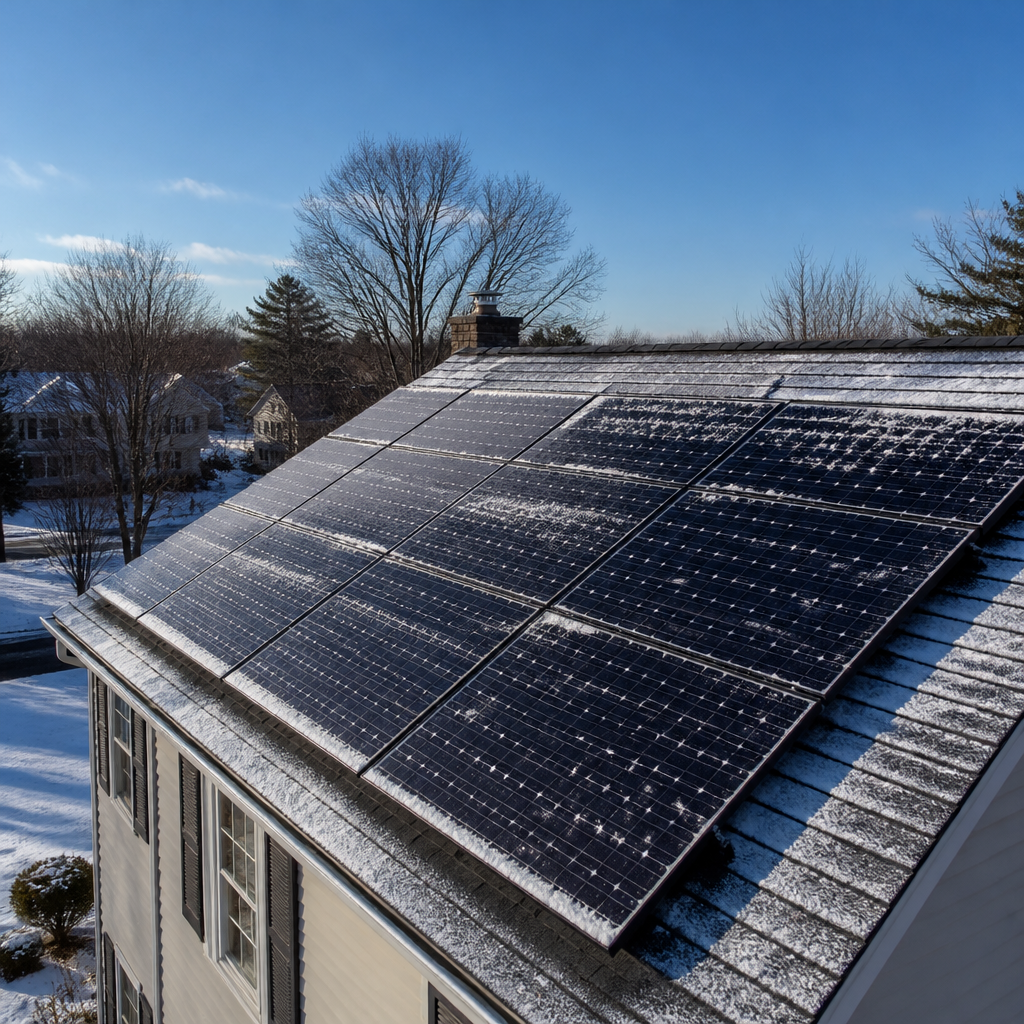
The reverse relationship holds in cold weather. On a clear winter day, a module operating at a lower temperature can produce more power than the same module on a hot summer afternoon under similar light levels. Published explanations of this cold-weather benefit, including the articles listed in the references, describe the same pattern. Cold alone rarely explains a weak winter reading.
A solar equipment retailer's case study comparing hot and cold climates reports that bright, cold days can push output above a panel's rated capacity, in some cases by 10 to 15 percent. This figure describes favorable conditions rather than typical monthly results. Rated capacity is measured under standard test conditions, and real arrays seldom sustain that level across a full season.
Cold temperatures rarely cause a weak winter result. In most cases, the limiting factor is the amount of light reaching the array.
Winter output still depends on the whole system. Inverter limits, voltage operating range, wiring losses, and module temperature interact, and an undersized or aging inverter can cap output on a cold, sunny day regardless of how favorable the panels are. For this reason, cold-weather performance should be judged at the system level rather than from the module datasheet alone.
Pro tip: Compare morning and midday output on clear winter days with the same hours on clear days in a mild month. If winter figures are low in both cases, the likely causes are shading, soiling, or a hardware fault rather than temperature.
Shorter Days and Low Winter Sun Angles
Daylight Hours Across the Mid-Atlantic Winter
Day length is the largest seasonal factor in winter solar production. Around the December solstice, most of the Mid-Atlantic receives about nine and a half hours of daylight, compared with roughly fifteen hours near the June solstice. An array that generates strongly from late morning to mid-afternoon in July has a much shorter productive window in January.
This difference explains much of the gap between summer and winter energy totals. A system performing in line with its design expectations may still report a monthly total that is a fraction of its July figure. Comparing months with different daylight hours without adjustment leads many owners to conclude that a system has failed when it has not.
How Low Sun Angles Reduce Light Reaching the Array
In winter the sun sits lower in the sky, so its rays strike the module surface at a more oblique angle. Less energy reaches each square meter of panel, and a larger share is reflected away. The effect is strongest in early morning and late afternoon, when nearby structures and trees can cast long shadows across the array.
A common mistake is treating the lower angle as a fault. Output that declines in step with irradiance data for the same days reflects normal seasonal behavior. A decline that appears while irradiance remains high points to a different cause, such as soiling, shading, or equipment problems.
Tilt and Orientation Trade-Offs in Winter
Most residential arrays are mounted at a fixed tilt chosen for annual performance. A steeper tilt generally favors winter production because the panel faces the lower sun more directly, while a shallower tilt favors summer. On ground mounts and some adjustable racks, installers can tune this balance. On a fixed rooftop array, the practical levers in winter are keeping modules free of shade and maintaining clean glass.
Pro tip: Before concluding that roof orientation or tilt is the problem, pull irradiance data for the same winter days and compare the ratio of output to irradiance. This comparison separates seasonal geometry from actual faults.
Snow Cover and Ice on Panels
How Snow Blocks Light Even When the Layer Is Thin
Snow is the most visible winter obstacle for solar production, and it can block output more completely than cloud cover. A layer covering only the lower rows of an array can reduce output by more than its visible area suggests, because of how modules are wired. Arrays are commonly connected in series strings, and a shaded module can limit the current of the entire string unless the system uses module-level electronics.
Partial coverage therefore produces uneven results. A roof with snow remaining on the bottom row while the rest of the array is clear may show a steep drop in production. Clearing the lower edge often restores much of the lost output within the same day, once sunlight warms the glass.
Ice Dams, Refreezing, and Access Risks
Ice is harder to manage than snow. Meltwater can refreeze at the eaves and form ice dams, and a glazed layer of ice on the modules can persist for days in areas that receive little morning or midday sun. Mid-Atlantic winters often bring repeated cycles of thaw and refreeze, which produce this condition more often than a single hard freeze.
Access is the most serious risk. Snow and ice make roof surfaces slippery, and a fall from a residential roof can cause serious injury. Homeowners should not walk on a snow-covered or icy roof to clear panels. Where a roof cannot be reached safely, a licensed contractor with appropriate equipment should handle removal or ice management.
Safe Snow Removal Practices
Where access is safe from the ground, a soft, non-abrasive roof rake can pull snow from the lower panel rows. Metal tools, scrapers, and high-pressure water can scratch module glass or damage frames and seals. Pouring hot water on ice is also a poor practice, because thermal shock and refreezing can crack glass or create additional ice.
Snow removal is a matter of selective effort, not full clearing. Removing snow from the bottom row is usually enough to restore most output, and the sun clears the remainder. Owners who clear snow should record the date and output before and after, which helps determine whether snow or another factor caused a later drop.
Pro tip: Clear only the lowest row from the ground with a soft roof rake, and never step onto a snow-covered or icy roof for panel work. If ice has built up at the eaves, contact a licensed electrical contractor rather than attempting removal yourself.
Clouds, Rain, and Mid-Atlantic Weather Patterns
Overcast Days and Diffuse Light
Overcast skies reduce direct sunlight, and many winter days in the region are cloudier than summer days. Solar panels still generate under diffuse light, but output falls substantially when a thick, low cloud deck persists for several days. Published explanations of solar performance note that clouds reduce output because they block sunlight from the PV cells.
Some cloud conditions produce brief increases in output. When sunlight reflects off the edges of clouds, panels can receive more light than on a clear day for short periods. These spikes are real, but they are short and should not be used to set expectations for monthly production.
Coastal and Inland Variation Across the Region
The six jurisdictions covered by this guidance do not share one winter climate. Areas farther inland and at higher elevation generally receive more snow than coastal areas, so the snow-related factors described earlier tend to matter more there. Coastal properties more often experience cloud and moisture patterns that reduce direct sunlight on certain days.
Expectations should therefore be set against local weather records and irradiance data for the specific location. Two systems with identical equipment and orientation can show different winter totals if one sits in a coastal suburb and the other at higher elevation.
Rain and Cleaning Effects
Winter rain can help keep panels clean by washing away dust and pollen. Rain followed by rapid cooling can freeze into a glaze on modules, so the timing of rain relative to temperature matters. A clear, cold day after rain can show strong output when the glass is clean and free of ice.
Measuring Winter Output Against Expectations
Comparing Output With Irradiance Data
The most reliable test of winter performance compares actual production with the solar energy available on the same days. Irradiance data from a nearby weather station, a satellite-based dataset, or a monitoring platform that records plane-of-array irradiance provides this reference. Comparing the ratio of output to irradiance across days isolates equipment behavior from seasonal change.
Summer totals are the wrong benchmark for winter. A fair comparison uses the same month in the prior year, adjusted for weather, or a modeled expectation based on system size, orientation, and tilt. Owners who compare January with July will almost always find a shortfall, regardless of system health.
Monitoring Data and What to Check First
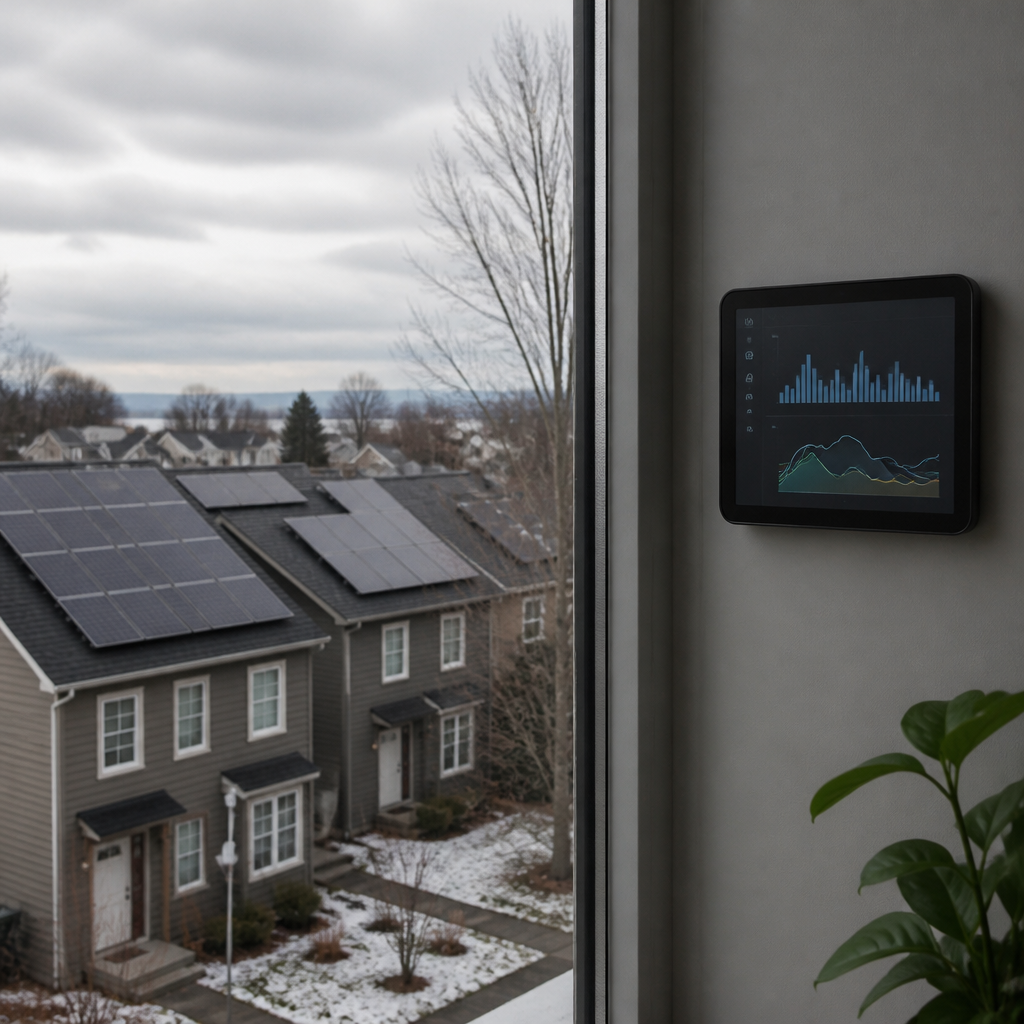
Monitoring systems typically report inverter output, daily production, and in some cases module or optimizer data. When winter output appears low, the first checks should be the inverter status log, any error codes, and whether production drops at the same hour each day. A consistent drop at a fixed time often indicates shading from a structure or tree, while irregular drops often point to snow, soiling, or weather.
Patterns That Signal an Equipment Fault
Some patterns warrant a service visit rather than patience. A gap that persists across several clear days with high irradiance is one example. Another is an inverter that repeatedly restarts, reports a ground fault, or shows one string well below the others. These conditions should be checked by a licensed electrician, since loose connections and damaged conductors can create safety hazards as well as production losses.
A single low day says little about system health. A repeated gap under strong sunlight says a great deal.
Keeping a simple log helps. Recording the date, weather, snow conditions, and daily output allows a technician to distinguish weather-driven patterns from a developing fault.
Winter Maintenance Steps That Protect Output
Inspection Before the First Hard Freeze
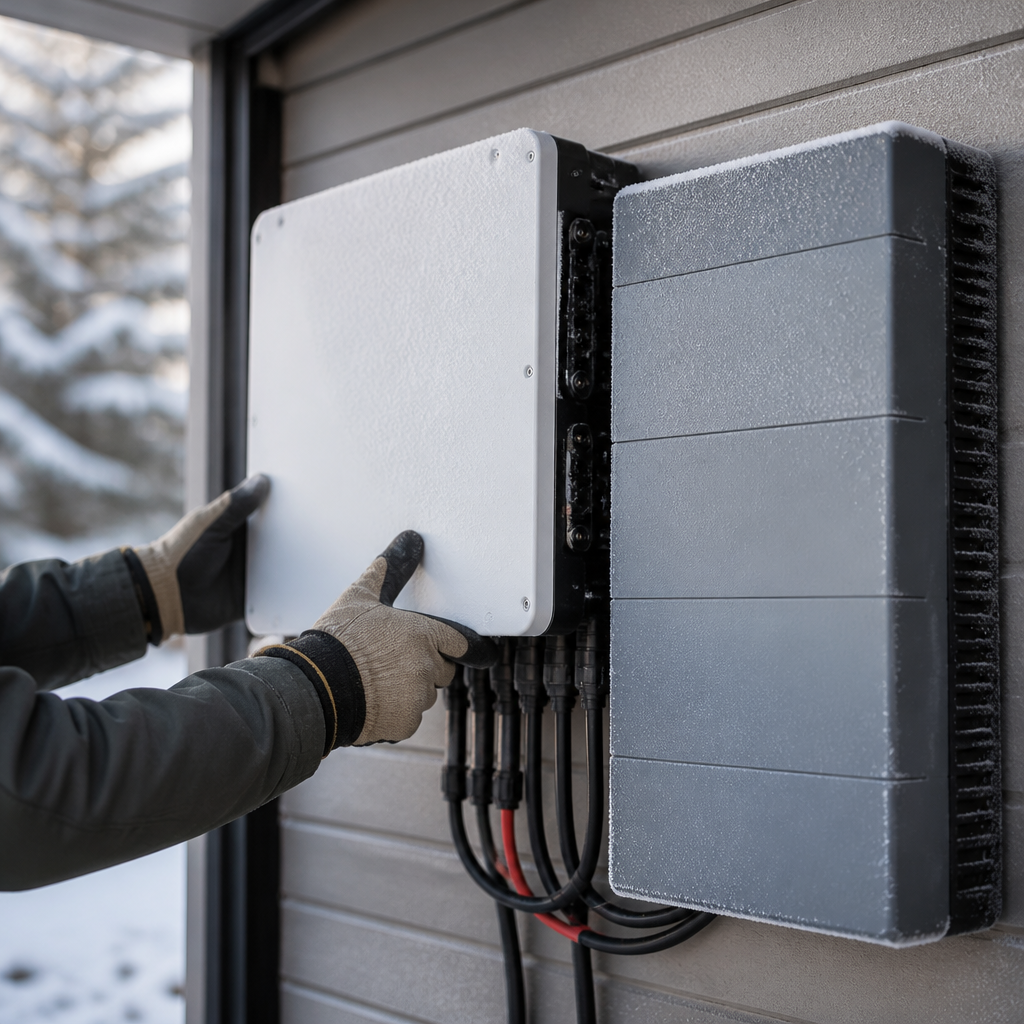
A winter inspection before the first hard freeze identifies problems that cold, wet, or freezing conditions can make worse. A technician should check junction boxes, connectors, roof penetrations and flashing, mounting hardware, conduit, and the inverter enclosure for moisture or corrosion. Loose connections increase resistance, which produces heat and reduces output, and they become more likely as materials contract in cold weather.
The inspection should also confirm that monitoring data matches expected behavior and that disconnects, breakers, and labels remain accessible and undamaged.
Keeping Modules Clean Without Causing Damage
Rain and melting snow clean most residential panels adequately during winter. When soiling is heavy, owners can clean the glass with a soft brush and clean water on a mild day when the surface is not frozen. Pressure washers, abrasive pads, and harsh cleaning compounds can damage anti-reflective coatings and seals, and water left on a frozen roof creates its own hazard.
Vegetation and Shadows That Change in Winter
Deciduous trees lose their leaves in winter, which may seem beneficial for solar access. Winter shadows are longer, however, because the sun is lower. Structures and trees that cast little shadow in summer can shade the lower part of an array in December. A tree that appears too distant to matter in July may shade a row of panels during late afternoon in January.
Pruning or removing affected branches should follow measured shading losses and consider the broader effects on the property. Tree work based on solar output alone can overlook other considerations, so the decision should be made with an arborist and based on the production data.
Comparison of Winter Performance Approaches
Three approaches address most winter output problems in residential systems. Each targets a different cause, and each has clear limits. The table below summarizes where each is most useful and where it falls short.
Approach | Where It Helps Most | Limitations |
|---|---|---|
Ground-level snow removal with a soft roof rake | Arrays with safely reachable lower rows where snow blocks a few rows of modules | Cannot address ice, upper rows, or roofs without safe access |
Module-level electronics such as microinverters or power optimizers | Arrays with partial shading from snow, dormers, chimneys, or seasonal tree shadows | Requires compatible equipment and does not add light; retrofits involve additional cost and labor |
Professional diagnostics and electrical inspection | Systems with output gaps that weather records and irradiance data do not explain | Requires a scheduled visit and a service fee; cannot change weather or daylight hours |
Selecting among these approaches depends on the cause identified through output data. Snow removal addresses a visible, temporary problem. Module-level electronics address shading that recurs each season, while diagnostics identify faults that no amount of cleaning will fix. In practice, many properties benefit from the diagnostic step first, because it shows which of the other approaches is worth pursuing.
Electrical Upgrades That Support Winter Production
Battery Storage for Short Winter Days
Winter solar production is limited by daylight, and the generation window closes by mid-afternoon. A battery storage system can capture midday output and hold it for evening use, when heating, lighting, and cooking loads are typically high. Storage does not add energy, so its value depends on how much the array produces and how the home consumes electricity. Sizing should rely on measured winter consumption rather than summer totals.
Panel and Service Capacity for Winter Loads
Winter brings higher electrical demand from electric heat pumps, resistance heating, and EV charging. An electrical service or panel that performed well in summer may be constrained when these loads run together. A licensed electrician can evaluate the main service, branch circuits, and load calculations to determine whether an upgrade is needed before new equipment is added.
Timing EV Charging and Household Loads
Electric vehicle charging can be scheduled to match the hours when the array produces the most energy, or to run overnight when grid electricity may be less expensive under certain utility rate plans. Scheduling is one of the simplest ways to increase the share of winter solar output used on site. Homeowners should confirm their rate structure before setting schedules, because time-of-use rules differ by utility and by plan.
Triple R Energy provides electrical panel and service upgrades, battery storage installation and service, and EV charger installation across the region. Its licensed electricians can evaluate winter loads and production together before recommending equipment.
Pro tip: Before adding an EV charger or heat pump, ask an electrician to review the home's peak load in January. Winter demand is often the constraint that determines whether an additional circuit or service upgrade is required.
Frequently Asked Questions
Do solar panels produce less electricity in winter?
Yes. Total winter production is usually lower than summer production, mainly because days are shorter, the sun sits lower in the sky, and overcast weather is more frequent. Cold temperatures themselves generally do not reduce output and can improve module performance on clear days.
Do solar panels work in freezing temperatures?
Yes. Solar cells convert light into electricity, so freezing temperatures do not stop generation. Output depends mainly on how much light reaches the modules, and cold does not interrupt the conversion process.
How much snow on a solar panel stops production?
No single depth applies. Snow density, panel tilt, surface temperature, and wiring layout all affect how much output is lost. Even partial coverage of the lower rows can reduce production significantly in a string-wired array.
Should I clear snow from my solar panels?
Clearing the lowest row from the ground with a soft roof rake is a reasonable step when access is safe. Homeowners should not climb onto snow-covered or icy roofs, and ice removal at the eaves should be handled by a licensed contractor.
Can a battery help with winter solar output?
A battery cannot increase the energy the array produces, but it can store midday generation for use in the evening. Its value depends on winter consumption patterns, the size of the array, and the utility rate structure.
What should I check if winter output seems low?
Compare daily output with irradiance for the same days, review the inverter status log for error codes, and check whether the shortfall occurs at the same hour each day. A repeated gap under clear, bright conditions warrants an inspection by a licensed electrician.
We welcome feedback from homeowners and property managers across the Mid-Atlantic on how winter weather has affected their systems and which monitoring observations proved most useful when comparing production with local conditions.