Households with two plug-in vehicles often find that the charging question depends less on the cars than on the home's electrical system. A single Level 2 charger may serve two vehicles on a predictable schedule, while other homes need a dedicated circuit, a dual charger, or a panel upgrade before a second car can charge without overloading the service. Understanding how two EV chargers at home interact with circuit capacity, panel size, and permitting helps homeowners avoid paying for unnecessary work or installing equipment their service cannot support. This article outlines the electrical requirements that matter most for homes in Delaware, Maryland, Pennsylvania, Virginia, Washington, D.C., and the wider Mid-Atlantic region.
Table of Contents
- Quick Takeaways
- How Much Charging Each Car Requires
- Sharing One Charger and Using Level 1 as a Backup
- Load Calculation and Service Capacity
- Choosing a Two-EV Charging Setup
- Permits, Codes, and Licensed Installation
- Panel Upgrades With Smart Panels
- Battery Storage and Solar With Two EVs
- Frequently Asked Questions
- References
Quick Takeaways
Key Insight | Explanation |
|---|---|
Daily mileage determines the charging method | Two cars driven about 40 miles per day each can often share one Level 2 charger by alternating nights. |
Level 1 works as a backup, not a daily plan | Level 1 charging typically adds three to five miles of range per hour, which suits occasional top-ups. |
A dual charger still draws from one circuit | Two vehicles charging at the same time share the capacity of a single electrical circuit. |
Load calculation should come before purchase | A licensed electrician should confirm available service capacity before equipment is selected. |
Panel condition can limit a second charger | Full or outdated panels often require an upgrade before an additional Level 2 circuit can be added safely. |
Permits protect coverage and resale | Charging installations must follow local and state codes, and many jurisdictions require a permit and site plan. |
How Much Charging Each Car Requires
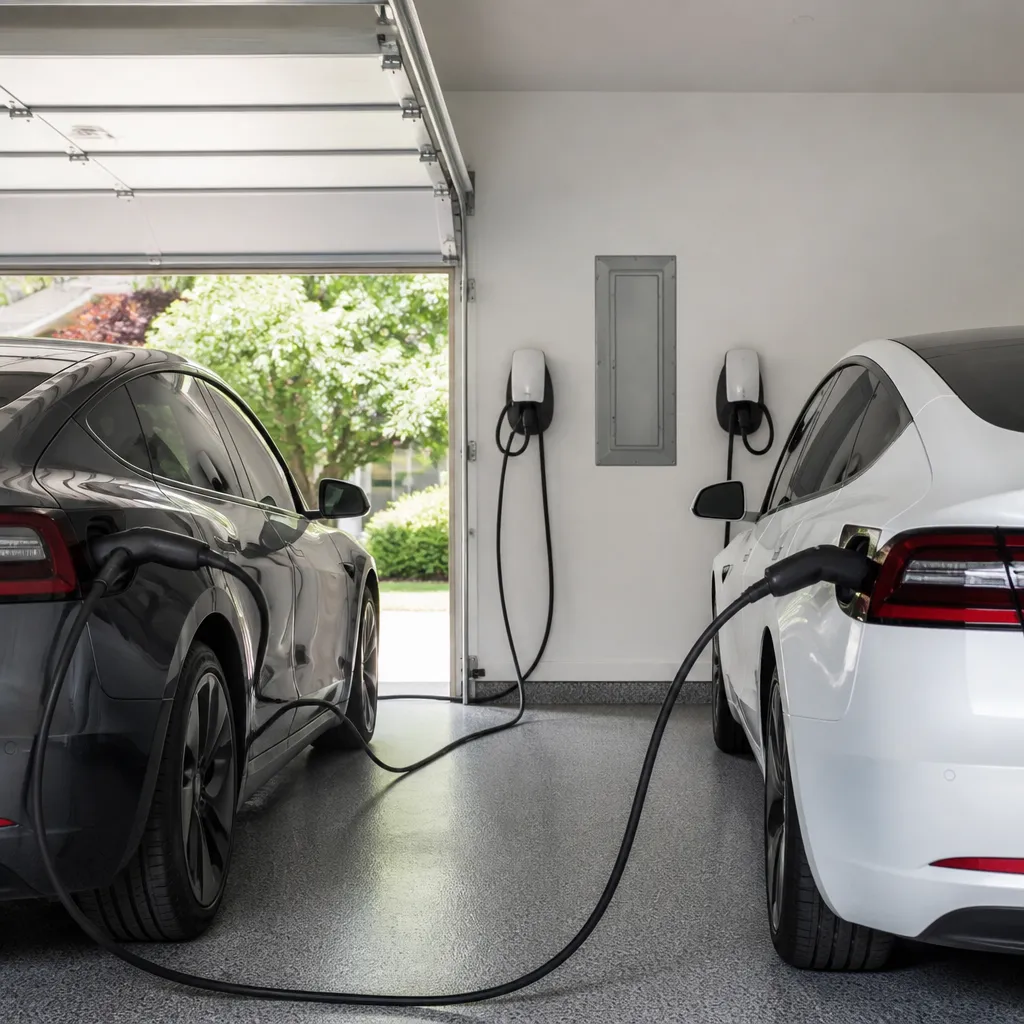
Before comparing equipment, a household should establish how much energy each vehicle uses on a typical day. The most useful figure is the daily distance each car travels, not the total odometer reading or the battery size listed on a specification sheet. Two cars with identical batteries can have very different charging needs if one commutes 60 miles daily and the other is used only for errands.
Measuring Real Daily Driving
A practical starting point is a two-week log of each vehicle's daily mileage, including weekday commutes and weekend trips. Averages from that log reveal whether the household needs to replace a full charge each night or only a partial top-up. Households that rely on the car with the highest daily use should plan around that vehicle first.
EnergySage's guidance on two-vehicle households frames the decision around three factors: how far each car is driven daily, what charger is already installed, and how much convenience the household wants to pay for. Those factors give homeowners a clear way to evaluate options before any electrical work is scoped.
Charging Speed and Replenishment Time
According to EnergySage, a Level 2 charger can replenish a typical daily drive in two to three hours. Level 2 equipment operates at 240 volts, and the Department of Energy's Alternative Fuels Data Center identifies it as the option for drivers with longer commutes or larger batteries that need more than an overnight dwell time to charge fully.
The right charging setup for a two-car household is the one that restores both vehicles to their required energy level within the hours they are parked, at a load the home's electrical service can carry without repeated interruptions.
The distinction between replenishing a daily drive and filling an empty battery matters for equipment choice. A household that drives modest distances can often meet both vehicles' needs with less capacity than a household that frequently needs a full charge.
Sharing One Charger and Using Level 1 as a Backup
For many households, the lowest-cost option is to share one existing Level 2 charger between two vehicles. This approach requires no new circuit and no additional hardware, but it depends on predictable driving patterns. Alternating charging days or nights is the core of the strategy.
Alternating Nights on One Level 2 Charger
EnergySage describes a scenario in which average daily driving is around 40 miles per vehicle. Under that pattern, one car can charge on one night and the other on the next, restoring about 80 miles of range every other night in roughly three to four hours. The schedule also allows charging during lower overnight utility rates where those rates are offered.
This method works best when neither vehicle has an unpredictable schedule. A household where one driver occasionally takes a long road trip on short notice may find that alternating nights leaves a car with insufficient range when it is needed most.
Pro tip: Before setting charge timers for alternating nights, confirm the utility's off-peak start and end times, and program the charger to finish before the first morning departure.
Using Level 1 as a Supplement
A Level 1 cordset that came with the vehicle can serve as a backup for occasional simultaneous charging. Level 1 charging typically adds only three to five miles of range per hour, so it works for short top-ups rather than a full daily charge. Many owners find that a standard outlet on a dedicated branch circuit is sufficient for this purpose.
Using Level 1 for a second vehicle should be treated as a limited measure. A household that depends on Level 1 for daily energy needs will usually find that a Level 2 installation is the more reliable path.
Load Calculation and Service Capacity
The most important question for any two-vehicle household is whether the electrical service can support two charging loads without exceeding its capacity. The answer depends on the existing demand from appliances, heating, cooling, and water heating, as well as the rating of the main service and the panel. An accurate load calculation is the only reliable basis for that decision.
What the Electrician Measures
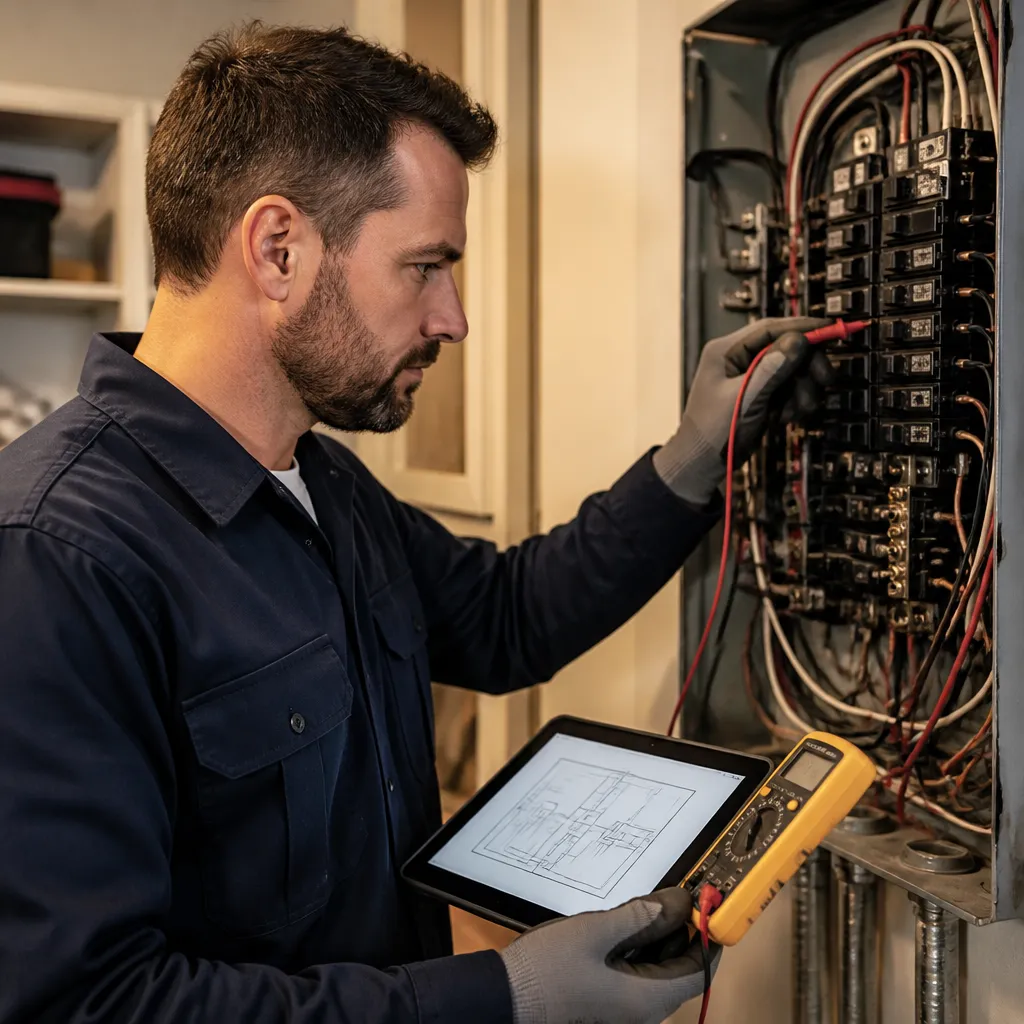
A licensed electrician typically reviews the main service rating, the existing panel capacity, the number of open breaker spaces, and the household's major loads. Electric ranges, electric heat pumps, electric water heaters, and central air conditioning all draw significant current. Homes with several of these appliances often have less spare capacity than their owners expect.
The Alternative Fuels Data Center notes that electricians can determine whether a home has adequate electrical capacity for vehicle charging. Where capacity is limited, a qualified electrician can add circuits to accommodate Level 2 charging, although the scope of that work depends on the existing service.
Continuous Load Rules for EV Circuits
The National Electrical Code treats EV charging infrastructure as a continuous load, a classification the Alternative Fuels Data Center highlights in its guidance. Continuous loads are sized more conservatively than intermittent loads, and NEC Article 625 contains most of the requirements that apply to charging equipment. Installers in Maryland, Virginia, and other service areas apply these same code principles.
In practical terms, a 40-ampere, 240-volt circuit is commonly used for a Level 2 charger, and the charger is set to draw a reduced continuous current from that circuit. Two chargers on two such circuits can create a combined demand of roughly 64 amperes when both vehicles charge at once, which can be significant on a modest service. Households should not assume that two chargers can run at full output together without a calculation.
Pro tip: Request a written load calculation that shows existing demand, proposed charger demand, and remaining capacity before purchasing any equipment.
Choosing a Two-EV Charging Setup
Once the driving pattern and service capacity are known, the household can compare the main configurations. Each option has a distinct cost, convenience level, and electrical requirement, and the best choice often depends on whether the household values automation, budget, or the ability to charge both vehicles at once.
Comparing the Three Main Approaches
The table below summarizes the three configurations most often considered in residential projects. Costs and capacity requirements vary by home, so the electrical assessment should confirm which option the service can support.
Setup | Best Fit for Households | Electrical Requirement |
|---|---|---|
One Level 2 charger shared on alternating schedules | Two cars with moderate daily driving and predictable routines | One existing or new 240-volt circuit with no added simultaneous demand |
Dual charger with two cables on one circuit | Households that want both cars charged at once without moving plugs | One circuit sized for the combined output, with capacity confirmed by load calculation |
Two dedicated Level 2 circuits | Households with long commutes or large batteries that need full charges each night | Two separate circuits and enough service capacity for both chargers operating together |
Matching the Setup to Household Habits
A household that can rotate charging without inconvenience should begin with the lowest-demand option. A household that frequently needs both cars ready at the same time has a stronger case for a dual charger or a second circuit, provided the service can carry the added load.
EnergySage notes that a dual charger is a single unit connected to a single electrical circuit, and that its convenience comes with a trade-off in charging speed when both vehicles draw power together. Homeowners should understand that a dual charger reduces the number of cords and moves to manage, but it does not add electrical capacity.
Permits, Codes, and Licensed Installation
Charging equipment must comply with local and state codes and regulations, and appropriate permits may be required from the local building and permitting authority. Skipping this step can create problems with insurance claims, home sales, and future electrical work. Permitting requirements are not identical across the Mid-Atlantic, so each project should be reviewed with the authority that has jurisdiction.
Permits and Site Plans
The Alternative Fuels Data Center reports that in many areas a site installation plan must be submitted to the permitting authority for approval before installation begins. That plan typically shows the location of the charger, the circuit route, the panel connection, and the equipment specifications. Submitting a complete plan early reduces the likelihood of inspection delays.
Permitting authorities in Delaware, Maryland, Pennsylvania, Virginia, and Washington, D.C. set their own procedures. A licensed contractor familiar with the local jurisdiction can determine which documents are required before work begins.
Why Licensed Installation Matters
The Department of Energy's guidance on EV charging installations emphasizes that work of this type should be completed by a licensed electrical contractor. Licensed installers are trained to apply the National Electrical Code, select appropriately rated equipment, and document the work for inspection.
Outdoor installations also require outdoor-rated equipment. The Alternative Fuels Data Center confirms that outdoor charging is safe when the equipment is rated for that environment. Safety-certified equipment is recommended for both garage and outdoor installations.
Pro tip: Ask the installer to confirm that the charger carries a recognized safety certification and is rated for the intended location before the unit is ordered.
Panel Upgrades With Smart Panels
A panel upgrade is often the solution when a home has the service capacity for one charger but not for two. The panel distributes power to every circuit in the house, and an older or fully loaded panel can leave no room for a second 240-volt breaker. Replacing or upgrading the panel can create that capacity while improving the reliability of the entire electrical system.
Signs a Panel Upgrade Is Needed
Several conditions suggest that a panel may not support additional charging. These include frequent breaker trips during peak usage, a panel with few open spaces, outdated equipment from a manufacturer no longer producing parts, and a service rating that is low relative to the home's loads. A load calculation will confirm whether any of these conditions limits the planned installation.
Homes that rely on electric heat or cooking appliances often reach panel limits sooner than other households. In those cases, the upgrade decision should be made alongside the charging plan rather than after the first charger is installed.
Smart Panel Options for Load Management
Our team provides SPAN Smart Electrical Panel installation as part of our residential electrical upgrade services. Smart panels can monitor circuit-level demand and, depending on the configuration, help coordinate charging so that two vehicles do not draw more power than the home can supply at a given time.
Load management features reduce the need to size the service for the worst case, but they do not eliminate the need for a load calculation. Homeowners should review the planned configuration with their installer and confirm how the system behaves when multiple large loads operate at once.
Battery Storage and Solar With Two EVs
Homes that already have solar panels or battery storage face additional considerations when adding two chargers. Solar production and battery discharge patterns interact with charging schedules, and an electrical assessment should address those systems alongside the vehicle loads. Coordinating the components reduces the risk of unexpected grid draw and underused solar output.
Coordinating Battery Storage With Charging Schedules
A battery storage system can supply power to the home during periods of high demand, which may include overnight charging. Whether a battery reduces the need for a panel upgrade depends on its capacity, its discharge limits, and how the household's loads are controlled. A battery cannot be assumed to cover two chargers without confirmation from the system design.
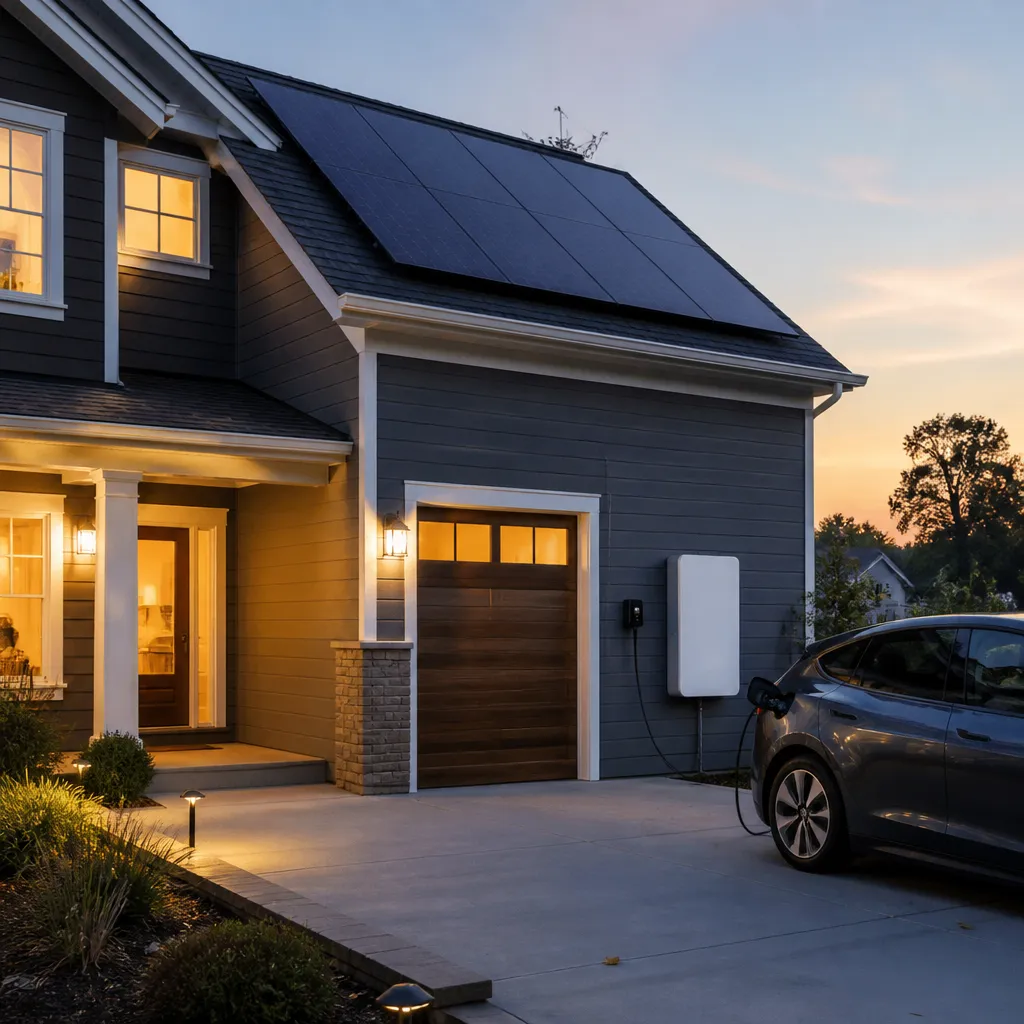
Batteries should be sized and programmed with the charging plan in mind. Charging a vehicle from a battery that is not fully recharged by solar can reduce the energy available for other household loads later in the evening.
Solar Output and Daytime Charging
Solar production peaks during midday, while most vehicles are parked at work or away from home. Households with solar may therefore find that overnight charging draws from the grid or the battery, unless the vehicles are home during daylight hours. Matching charging times to solar production is possible only when the schedule allows it.
Our solar system diagnostics and troubleshooting service includes a review of production records, inverter performance, and battery behavior. That review helps homeowners understand whether an existing solar system will be affected by new charging loads before the installation is scheduled.
Pro tip: Review at least a full year of solar production and battery records before adding chargers, since seasonal changes can alter both daily output and overnight energy availability.
Frequently Asked Questions
Can two electric vehicles share one Level 2 charger?
Yes, many households can share one Level 2 charger by charging the vehicles on alternating days or nights. This approach works best when each car is driven a moderate distance each day and the household has a predictable schedule.
Does a dual charger add electrical capacity to my home?
No. A dual charger has two cables but is connected to a single electrical circuit, so both vehicles share that circuit's capacity. A load calculation is still required to confirm that the service can support the charger's output.
How do I know whether my electrical panel can support a second charger?
A licensed electrician can determine this through a load calculation that reviews the main service rating, the panel's open breaker spaces, and the home's existing major loads. Frequent breaker trips or a nearly full panel are common signs that an upgrade may be needed.
Is a permit required to install EV chargers at home?
In many areas, a permit and a site installation plan are required before installation begins. Requirements vary across Delaware, Maryland, Pennsylvania, Virginia, and Washington, D.C., so the local building authority should be contacted before work is scheduled.
Can I install an EV charger outdoors?
Outdoor installation is safe when the equipment is rated for outdoor use. The Alternative Fuels Data Center notes that charging in the rain is safe with appropriately rated equipment, and a licensed installer can confirm the correct product for the location.
Does a battery storage system make a second charger possible without an upgrade?
It may reduce demand on the grid, but it does not automatically eliminate the need for a service or panel upgrade. The battery's capacity, discharge limits, and control settings must be evaluated together with the charging plan.
Readers who have added a second charger to a home in the Mid-Atlantic region are invited to share what their electrical assessment revealed and which charging setup has worked best in daily use.